Cloudflare has open-sourced Cloudflare OS, a platform intended to provide organizations with a shared workspace for AI agents, internal applications, the company’s knowledge, and automated workflows.
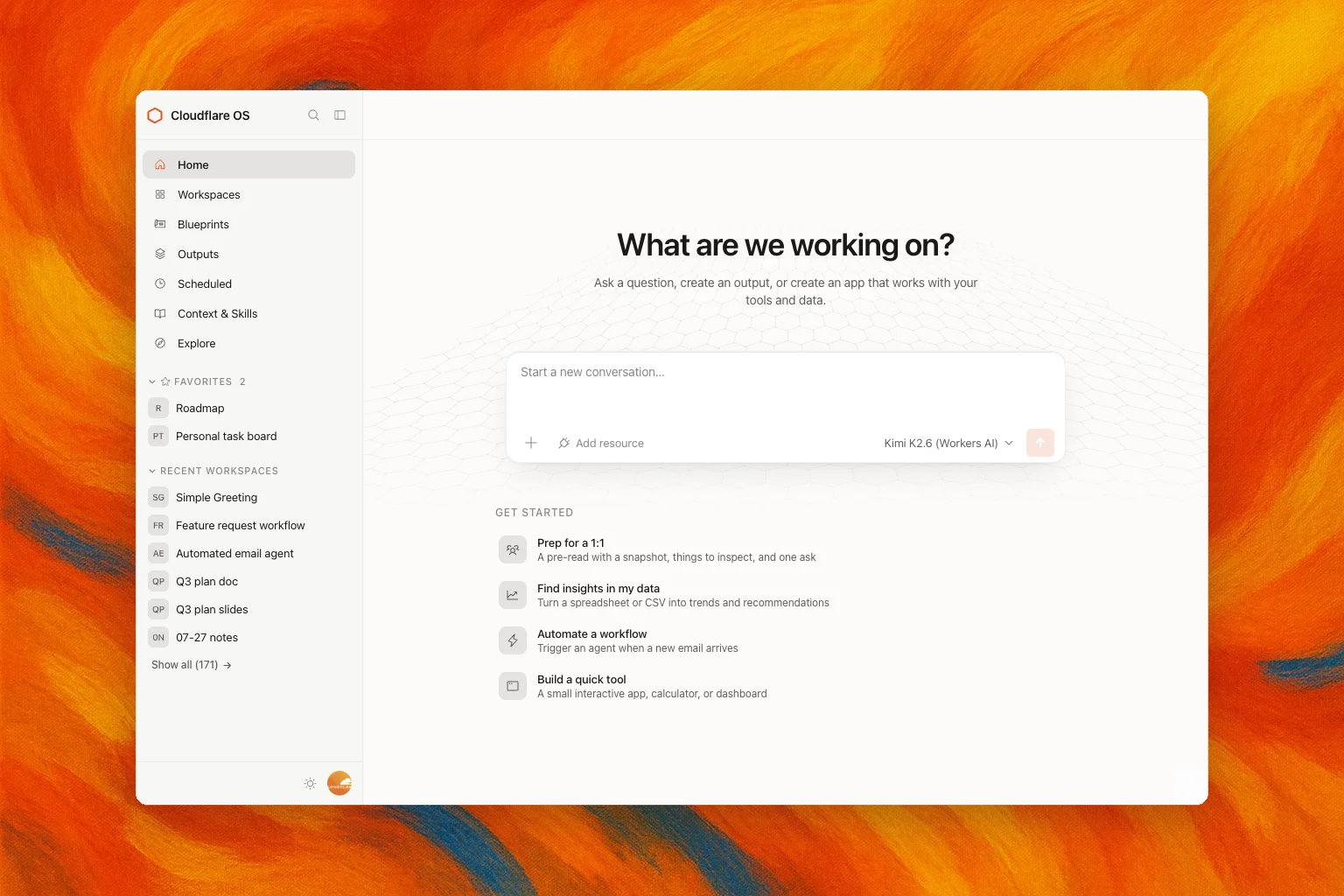
Although it bears the name of an operating system, it is actually not a traditional OS but rather a browser-based environment built on Cloudflare’s infrastructure and AI services, initially created for use by its own staff.
The first version was introduced within the company in May 2026, and Cloudflare adds that thousands of employees across various departments now use it daily to produce documents and presentations, automate repetitive tasks, and develop small applications for working with company data.
Security is incorporated directly into the architecture since Cloudflare uses what it refers to as Gatekeepers, which are Workers specific to a service, positioned between Cloudflare OS and external systems. They can hide certain fields, impose rate limits, manage OAuth credentials, record what an agent has accessed, and act as intermediaries for operations that result in externally visible changes.
A major component of Cloudflare OS is the way in which it handles applications. Rather than restricting users to a specific set of productivity tools, the platform enables an agent to develop applications tailored to an individual, a project, or a team. Such applications may consist of both client-side and server-side code.
On the backend, the server part is loaded on demand as a Dynamic Worker and is instantiated as a Durable Object Facet. Each application has its own SQLite database, separate from the Cloudflare OS runtime, and Dynamic Workers use lightweight V8 isolates to provide an isolated runtime without the need for a permanently running dedicated server or container.
There are two methods for sharing applications. Either the user can share the application itself, enabling others to work with the same state in real time, or they can share a blueprint that someone else can use to make an independent copy.
Cloudflare OS is also independent of any specific model; organizations can use it with any AI model, with inference requests going through the Cloudflare AI Gateway. Administrators are free to choose which models are available and which should be used for specific workloads rather than having every task processed by the same model.
For additional detail, see the announcement. At the moment, Cloudflare OS is available as open-source software on GitHub and also offers a starter deployment for any organization that wants to run it in its own Cloudflare environment.
Image credits: Cloudflare