Zabbix has announced the release of Zabbix 8.0 LTS, the latest long-term support version of its open-source infrastructure monitoring platform.
One of the biggest additions is native application performance monitoring powered by OpenTelemetry, allowing Zabbix to collect and analyze application traces, metrics, and logs alongside traditional infrastructure monitoring data.
The implementation uses Zabbix proxies to receive telemetry data from applications or existing OpenTelemetry collectors through OTLP/gRPC. A new APM section in the web interface provides access to the collected information, while a new telemetry query item type allows the data to be used in graphs and triggers.
ClickHouse support is another addition. The database can now serve as a backend for storing historical monitoring values and application telemetry data. According to the developers, the new storage architecture and server optimizations deliver up to a tenfold performance improvement while reducing CPU usage, disk I/O, and storage requirements.
Zabbix 8.0 also features a complex event processing engine that correlates related events, identifies potential root causes, and reduces duplicate alerts. Administrators can configure event processing rules, use JavaScript-based matching logic, and analyze events within configurable time windows. The engine groups related issues into causes and symptoms.
AI integration comes through a new MCP server. It allows compatible AI agents to retrieve monitoring information, examine problem histories, acknowledge alerts, adjust problem severity, and manage maintenance periods. Access follows existing Zabbix user permissions, so AI agents cannot perform operations beyond the privileges assigned to their API tokens.
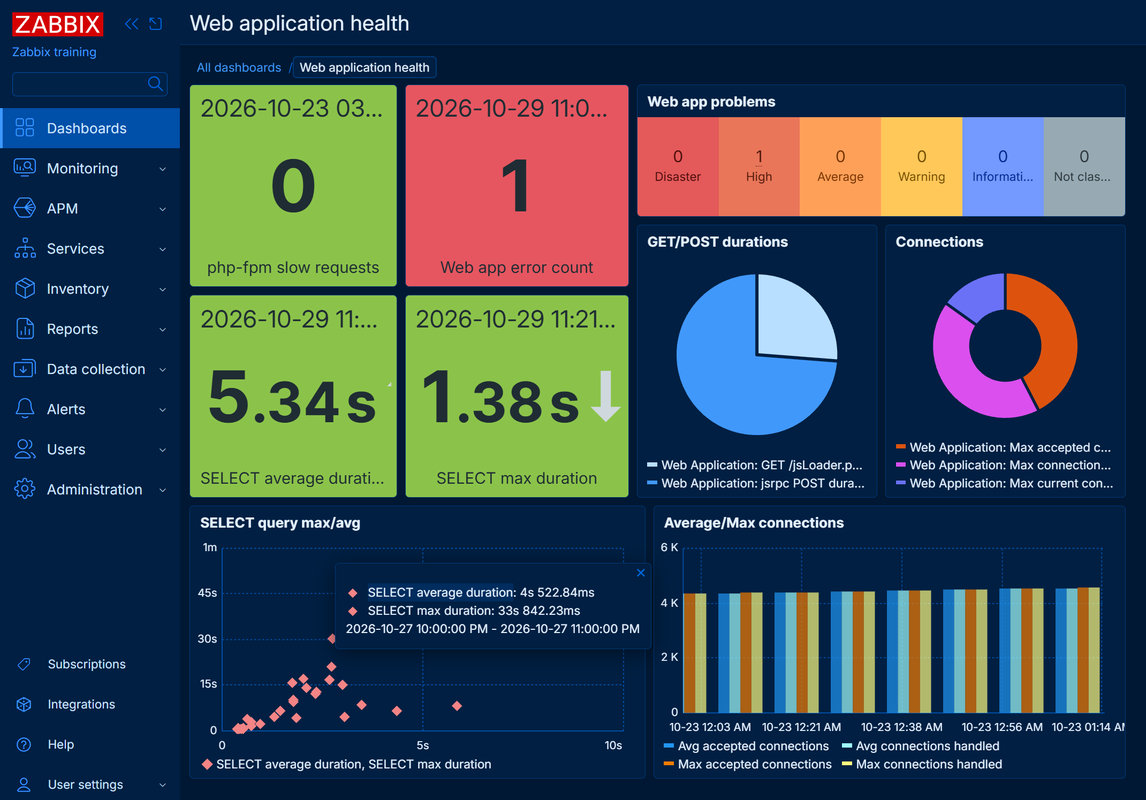
The web UI gains customizable table layouts for hosts, templates, and problems, permitting users to hide, resize, and reorder columns or display additional inventory information. Additionally, a new dark blue theme, inline form validation, and support for importing SAML certificates directly through the interface are included.
Dashboard functionality has been expanded with import and export support for YAML, JSON, and XML formats. A new Scatter Plot widget helps detect correlations between metrics. Graph widgets gain additional interaction options. Plus, the Geomap widget can now cluster nearby markers, making larger monitoring maps easier to navigate.
The release also expands the available monitoring templates. New integrations cover Podman, Kubernetes, Proxmox VE, Microsoft Hyper-V, MariaDB, and Percona, along with services from AWS, Azure, Google Cloud, and Oracle Cloud. Templates for monitoring OpenAI Platform and Claude API usage are included.
On the security side, API access is disabled by default for user roles until explicitly enabled. Zabbix 8.0 also introduces HashiCorp Vault AppRole authentication, configurable restrictions for agent item keys, and the ability to export audit log records.
Additional improvements include support for multiple PostgreSQL backend nodes, a new JSON item data type, DNS caching and failover, faster historical data cleanup, and improved proxy load handling.
Finally, Zabbix is preparing an official mobile application for Android and iOS, offering incident notifications, problem management, and encrypted connections. However, the application is scheduled for release after Zabbix 8.0 and is not yet available.
For additional details, see the announcement or visit the Zabbix 8.0 release notes. According to the project’s support lifecycle, Zabbix 8.0 LTS will receive full support until November 30, 2029, followed by limited support through November 30, 2031.
Image credits: Zabbix