In almost every case, moving a file between two nearby devices usually involves a network connection, Bluetooth, a cable, or uploading it to a cloud service first. Decimen Optical Transfer takes a noticeably different approach: it sends the data through light.
Decimen is an open-source browser-based tool that converts a file into a continuous stream of animated QR codes displayed on one device. A second device points its camera at the screen, captures the codes, and reconstructs the original file. No direct network path, account, pairing process, cloud storage, or native application is required.
Using it is more than easy. Open the Decimen web app on both devices, select Send on the first, and choose a file. The animated QR stream begins immediately. On the receiving device, select Receive, grant camera access, and point it at the sender’s screen.
The project’s documentation recommends using a laptop as the sender, increasing its display brightness, and placing the receiving phone so the QR code fills as much of the camera view as possible. Once enough data is captured and the SHA-256 integrity check succeeds, the reconstructed file becomes available for preview and saving.
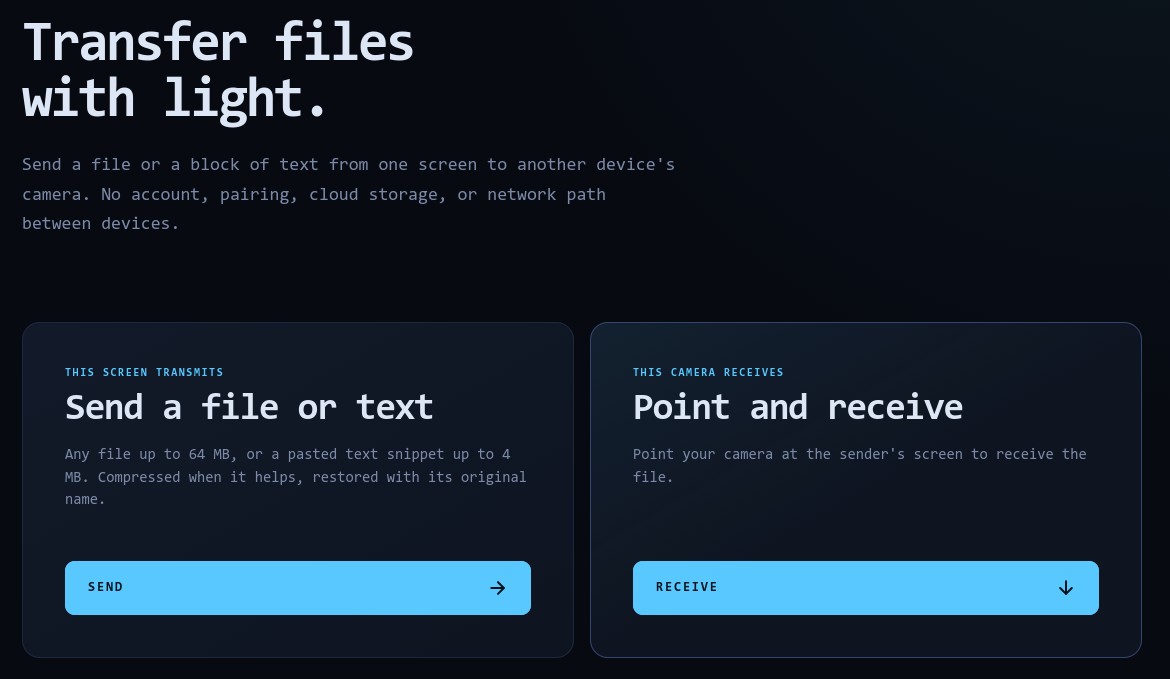
Decimen supports individual files up to 64 MB, while pasted text snippets can be up to 4 MB. It preserves the original filename and media type, applies gzip compression when it reduces the payload, and verifies the transfer before offering the file to the user. Received videos can also be played directly in the browser.
Behind the unusual interface is a more interesting technical detail. Instead of dividing the file into a fixed sequence of QR codes that must be scanned in order, Decimen uses Luby Transform fountain coding.
The sender continuously generates encoded frames, while the receiver collects whichever distinct frames its camera captures. According to the project, reconstruction typically requires about 115% of the minimum number of frames. Their order does not matter, and missing a frame only makes the process take longer, not corrupt the file.
Moreover, the developer reports that the larger experiment from which Decimen was extracted reached about 128 KB/s between phones, with the project page showing a transfer around 130 KB/s. Of course, that will not compete with conventional local networking, but the speed is not the main goal here. Instead, Decimen is intended for situations where establishing a network connection is inconvenient, undesirable, or impossible.
After the first visit, the web app can operate offline and may be installed as a Progressive Web App on iOS and Android. Those who prefer not to use the hosted service can run the project themselves. The repository includes development and production build commands, along with standalone builds containing self-contained sending and receiving pages.
There is, however, an important security limitation: Decimen does not encrypt the transferred content.
Removing the network connection does not make the transfer confidential. Any other camera capable of seeing the sending screen could potentially capture the same QR stream. The project therefore provides network isolation, not protection against anyone observing the display. One possible solution is to encrypt sensitive files separately before transferring them this way.
Decimen Optical Transfer is written primarily in TypeScript and distributed under the MIT license. Those interested in trying it can use the official Decimen web app directly or visit the project’s GitHub repository for the source code, documentation, and self-hosting instructions.