

Some Linux distributions have started restricting access from Brazil in response to concerns about a newly enforced digital law that could affect online software distribution in the country.
Community discussions on Reddit indicate that projects such as Arch Linux 32 (an independent 32-bit Arch derivative) and the Fedora-based Bazzite have either blocked Brazilian IP addresses or are assessing the situation.
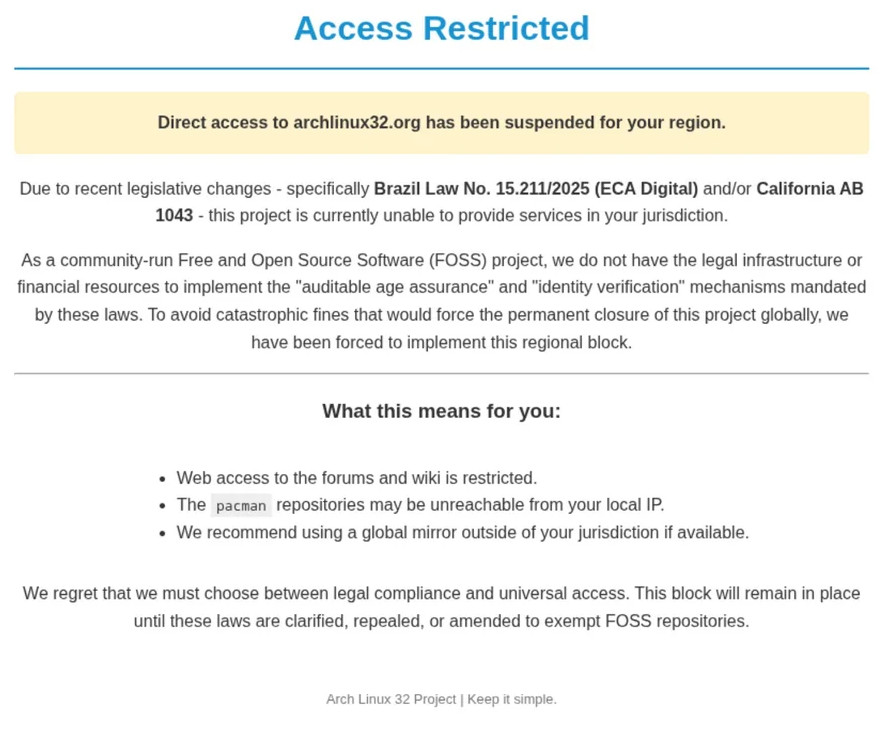
These actions appear to be precautionary and not coordinated, with each project independently assessing potential legal risks. In some cases, maintainers have not issued formal statements, so available information relies on user reports.
The issue is linked to Brazil’s Federal Law No. 15.211/2025 (original text in Portuguese), commonly known as the “ECA Digital.” The legislation, approved in September 2025, introduces new rules to strengthen protections for minors in online environments.
After a transition period of roughly six months, the law officially took effect on March 17, 2026, which aligns with the timing of the reported access restrictions.
The law imposes broad requirements on digital platforms and services accessible to minors, such as stronger safeguards and, in some cases, reliable age verification. However, its scope is not clearly defined and does not specifically mention open-source software or Linux distributions.
This ambiguity has led developers to worry that hosting downloadable Linux images could be considered a regulated digital service. In this case, projects might be required to implement compliance measures that are impractical for most open-source communities.
As a result, some maintainers have temporarily blocked access from Brazil or issued warnings while awaiting clearer legal guidance. Others are monitoring the situation without taking immediate action.
A recent notice on the Manjaro forum, posted before the law takes effect, points out the uncertainty that Linux distributions are facing. Developers say it may be hard to apply the new rules to open-source systems and are considering steps like installer warnings or limiting user profiles for minors. However, so far, there is no clear plan for compliance.
Further clarification from Brazilian authorities or regulators is expected to determine whether these restrictions will remain or be lifted.





Are these measures really going to help protect children?
The underlying issue here has more to do with government control over individuals than with protecting children. Why don’t they do the same with macOS, Windows, and Android, where the largest segment of the population uses these operating systems?
Furthermore, how are these measures going to prevent sexual predators from accessing social media? The question is rhetorical, because they’re not really for that purpose, are they?
Even questions like, “Are you a sexual predator?” won’t work.
The real measures would be actions like requiring complete user information, including age and a recent webcam photo, to block adults from accessing the same channels where teenagers connect. They would also need to identify those who use so many devices like AI, chatbots, and other means to disguise their true identity.
What does installing free software have to do with the above? Absolutely nothing.
Therefore, people must prevent such absurd laws from being implemented. Because now it’s this, and in the not-too-distant future, it will be regional internet access, just like CDs and DVDs have been for so long. Sooner rather than later, we will lose the few freedoms we have left.
Today, the internet is a shadow of its former self; everything is restricted and controlled. I’m surprised they aren’t able to locate the real groups of individuals who are truly dangerous to children.
The reality is they want to end anonymity. Some countries are talking about ending it all together. Using the children cushions it and makes it look like it’s for a noble cause. It’s all AI fault. When AI moderation got introduced into YouTube, it went down hill from there.
The PDF documents in the link below touch to the core of these issues:
zotum[dot]net[/]channel[/]pfsilva[?mid=681712db-dc57-4c0f-8a6a-74ae91b7b58b]
Portuguese: pg 44.
English: Pages 43/44
This has to be some weird paranoia episode tbh. The goal with the law is to regulate rampant minor abuse in the social media environments, gaming services and digital spaces suited for proliferation of sexual predators, s and so forth… No in the slightes have it anything to do with open source software. The article mentions fears that hosting OS imgs would be considered digital services, get real… we ourselves here in Brazil offer one of the most important hosting stacks in the world around the UFPR ecosystem, they themselves have absolutelly not been a part of this conversation, ignored it through and through, and they are in the territory. Take a deep breath and quit this rabit hole u got yourselves into
oh and i hope you know that whoever is the one avout to lift a Linux machine will get every image they want while laughing at the attempt to forbid the, right?
This has to
We’re living under censorship here in this hell called Brazil, this law was supposed to be a protective law in theory, but it only brings censorship to us. They’re blocking open source softwares, and lootboxes while we have casino’s and adult content legalized. The guy who protocol this law is under investigation of sa of minors. If you had a chance DO NOT COME TO BRAZIL
^pdf file
Brazilian MAGAtard living in an alternate reality…
California’s AB 1043 does pretty much the same thing. How will the Linux and FOSS communities handle a law impacting 10% of the U.S. population . . . and ANYONE traveling through the state with their cell phone on?
excuse me. the way I see it is just another mere topic.
none hightech software is worse causing harm than the male predator we women have to face and our kids are exposed to at home, around the hood, in the schools, work place, streets, disco of the real world.
what about the real world victims and cases are so deplorable, it is dificult to even talk about?
how dare you surprise?
who really are responsible about it.
“there is order in caus”, said a mathematician.
the only difference I notice is just the era, a noisy trend.
they have to talk about something.
society are very ill.
whatever.
thank
excuse m
As stated by others these laws have literally nothing to do with ‘protecting the children’ and everything to do with state surveillance
Building complete history on new generations from childhood on to be used by governments in ways you can only describe as Orwellian 1984
AI is taking BigTech spyware to levels of targeting groups & individuals at mere whims of politicians
In USA some states working to ban VPNs, of course under the guise of again ‘protecting the children’
We see dangerous bills pushing of visitors to the USA requiring 5 years of social media history, of course to ban those critical of current administration. This is all in the same vein of 1984 and it’s hitting everywhere and at every level
What starts as easily blocked/avoided becomes more difficult with each new tweaked & advanced methods used
Dangerous times, and with so many people apathetic of ‘nothing to hide’, and naivety in ‘for the children’ we are watching in real time as future generations truly lose all their freedoms, and mere targets of all things government & political agendas
Fight back as long as you can, it’s imperative
They will find other ways besides the children. From using anonymous harassment to claiming to stop bots. It’s just there to cater to maga crowd and to make it look like a noble cause.
Not true, this was another problem that already got resolved. We can access whatever we want.
Solved how? By whom? The stupid law is still in effect. There’s a big fine for those who don’t comply.
I want a movement to have all software that services regions with these laws blocked. “You want to regulate our tech? Now you can’t use it. It’s not our fault if your country can’t properly function now.”
I don’t think there should be any restrictions parental control is enough I think if you have the tech in your house similar to a gun proper protections should be forced if you have kids we all shouldn’t have to pay for others children. Do your job as a parent you are not their friends you are the adult and you should act like it damn with the kids raising kid shit.
Brazilian here. Arch is working fine, debian and ubuntu too. The law has flaws but no software repo will be affected, this is targeted to protect our children from awful environments.
Almost every other law made in here is usually worse than this one, our legislators are half dumb and half creating holes to exploit the laws.
“Protect our children ” – Iq 83
Please tell me, how a 17 year old have access to a computer/cellphone and a ISP without a single adult getting involved????
If someone wouldn’t leave their children alone in shopping center why they would do that in the internet??
it is only a issue for bad parents
“this is targeted to protect our children from awful environments.”
HAHAHAHAHAHAH!
Tell me your IQ < 60 without doing so explicitly.
“this is targeted to protect our children from awful environments.”
Oh, right. Just like carrying guns is prohibited to lower the rate of homicides and yet there were registered around 34k in 2025. Completely true. Have you read the law text? I have and every OS is REQUIRED to implement methods of age verification that are reliable and auditable BY THE GOVERNMENT, and also parental control.
Maybe you have not seen that Canonical is one of the scheluded businesses to be AUDITED regarding their age restriction methods?
Targeted to protect children, i see… 😆
Tell me: how is letting predators know that you’re a child going to protect children?
At least up till now they have to try and guess, but now they’ll know for sure and if you’re an adult they can show you benign content instead.
These laws are all BS and people should realize that and fight them.
I was able to get all the way to the arch download page using a Brazil vpn? I’m already on arch and it’s a vpn so maybe that’s why?
#ifdef Stupid_Jurisdiction
#endif
Good. Block them all. Take the burden of their stupidity back to them.
If only there was some technology to get around IP restriction…
Cuntrys that try to force their people to give up all privacy online don’t deserve having good software either, they should go crying to their greedy corpred sponsors like meta or political extremists that pushed this law thru in the first place.
I mean, maybe the government does not deserve good software, but I want it (Brazilian btw) thank goodness vpn exists
Why they have to strict access but not just give warning on their web or download page to prohibit user from the country to not use their products??
The law rules out age self-declaration, and enforces that the system is responsible to verify the use real age. So a warning wouldn’t be enough. I think it’s almost inpossible to comply to that in the open source world.
Bazzite was blocked by a mistake on the CDN configuration, as confirmed by the project itself https://x.com/bazzite_gg/status/2034286537723007222?s=46&t=LEA1Fjf38-hQaHNtpeyH-g
There is a lot of FUD being spread about the law, the ways that the law is going to be implemented are not defined yet and the law it is not targeted to small community based projects. A nice article can be found at https://www.tecmundo.com.br/software/411635-o-linux-sobrevivera-ao-eca-digital-contra-a-falacia-do-alarmismo-tecnologico.htm
This article was written by someone who is a technology analphabetic, like the one who wrote the law.
The whole article is about to explain that Linux is not affect, but doesn’t have a single proof, actually in the end of it, it just mentions the opposite, that Linux might be affect, and that’s ok.
THE law targets EVERY SOFTWARE. read it. it says all operating systems,, digital appliances and sites. ALL. go and read the law itself, it is clear as day.
I read that article. That article was a master class in double think and misdirection. This article does not in any capacity say that Linux will not be affected. In fact he iterates numerous times that Linux absolutely will be forced to comply and it does not have a choice in this manner. He is NOT saying ever at any point that Linux will get a pass on not implementing these requirements. He’s literally just saying “the government will go easy on Linux and give them time to comply”. That’s it.
From the article:
“However, the law does not aim to “punish” free software. It merely reinforces that technological safety for children and adolescents is a fundamental right that overrides the constituent elements of any computer program’s architecture. Freedom of code does not presuppose, nor should it imply, an absence of responsibility for exposing this audience to real risks.
…
It is also inconsistent to think that it would be impossible to implement age verification in Linux securely to protect personal data, privacy, intimacy, and other fundamental rights also guaranteed to children and adolescents, as well as adults. The Digital ECA, however, was conceived precisely as a legal catalyst for technological innovation.
…
The new legal requirements compel the industry to prioritize privacy and parental control solutions that have been completely neglected. Instead of blocking Linux, the Digital ECA (Brazilian Statute for Children and Adolescents) can actually encourage the creation of open, free, and free standards for secure age verification methods that respect individual rights. In this way, the Linux ecosystem would become even safer and more “family-friendly” than proprietary systems.”
The message here is completely unambiguous. All Linux distros will be forced to comply eventually. The only thing this article is claiming is that the government in their wisdom will use discretion to not punish Linux distros immediately but instead give them time to comply. There is absolutely no intention of allowing any Linux distro to bypass this, they are being extremely clear that all distros that do not comply will eventually be blocked.
Therefore the claims that everyone is just exhibiting unsubstantiated FUD is itself a BS claim. The article proves the government has every intention of blocking all Linux distros that refuse to comply. The only claim it’s making is that this is actually a good thing and we should all be going along with it.
“All Linux distros will be forced to comply eventually.”
Lol, no they won’t, and it’s impossible to verify your age on an open source OS because you can just modify the OS to say that you’re definitely 69 years old, trust me bro.
You might be missing the not-so-subtle call to action by the Brazilian Govt there – that we develop an age verification standard. One that protects privacy but also cannot be bypassed. Crypto can do this – you can’t bypass SSL even though your web browser and web server run on open source, for example – but the implicit point is no one has done this yet and no commercial software can be trusted to do so without also being, well, commercial (weakening privacy, making it cost, making it a walled garden implementation, and so on …)
Brazil is playing an interesting game here – oi, smart people, nice little ecosystem you’ve built here, shame if anything happened to it….
Toy sounds Luke the type that would destroy ‘nice little systems’. The type that would pass your sister over to the hestapo while you share a cigarette with the guard. You seem delighted about these restrictions. By the way, ‘children’ is the proxu word used in place of ‘Personal’. These restrictions are not about children, they are there to curb your knowledge and to limit your speech. If you haven’t realised this, you must be a child in an adult body
The only call made by the Brazilian gvt is for people’s data.