
Linux enthusiasts never cease to amaze with their efforts to revive memories of the recent past, and their latest endeavor is a perfect example. An experimental project called loss32 proposes a radically different vision for the Linux desktop: a system where the entire graphical environment consists of Win32 applications running under WINE rather than traditional Linux desktop software.
The idea behind loss32 is to build an open-source operating system that feels like a classic Windows desktop, but powered by the Linux kernel. To achieve this, instead of GTK or Qt applications, the desktop itself is composed of Win32 programs such as explorer.exe, Paint, and other familiar components, all running through WINE. At the same time, Linux applications remain technically available, but they are not the primary focus of the environment.
The project positions itself as a conceptual alternative to ReactOS. However, while ReactOS aims to reimplement the Windows NT kernel, loss32 deliberately avoids that approach. Its author argues that kernel reimplementation has been the main limiting factor for ReactOS’s hardware compatibility and long-term stability.
By relying on the Linux kernel and mature userspace components, loss32 seeks to deliver a similar end-user experience without rebuilding Windows internals from scratch.
At the core of the concept is the idea of Win32 as a stable application binary interface. The project highlights the practical advantage of being able to download and run decades’ worth of .exe software directly, including applications that were never ported to Linux or whose native ports have long been abandoned.
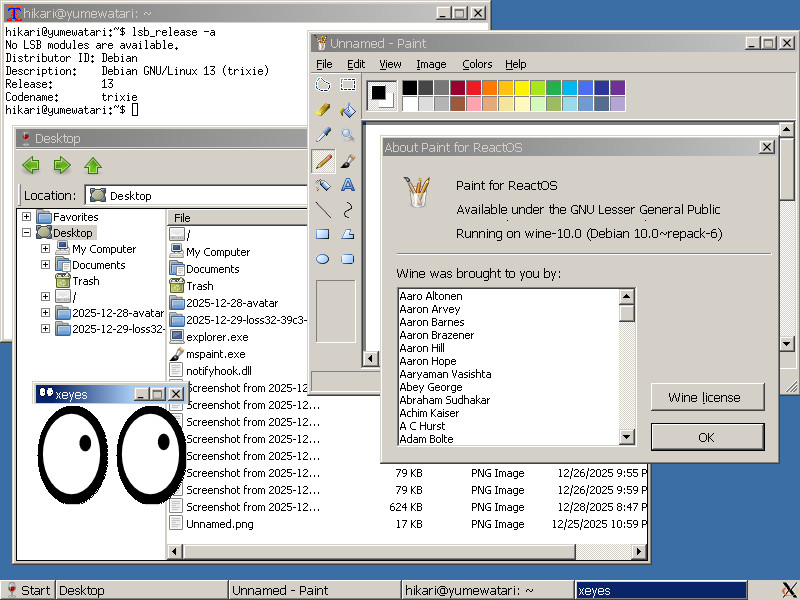
As you can see, the environment mimics the Windows Classic look, complete with a taskbar, a WINE-branded Start button, and Win32 applications coexisting alongside traditional X11 utilities such as xterm and xeyes. According to the author, however, there are still many rough edges, particularly around desktop integration, scaling, and shell behavior.
Development efforts are currently focused on improving WINE’s shell components, including explorer.exe and shell32 functionality, as well as resolving incompatibilities between WINE and selected parts of the ReactOS userland.
On top of that, the project is also experimenting with minimalist Wayland compositors that do not impose a conventional Linux desktop environment, allowing the Win32 shell to act as the primary interface.
One thing must be made clear immediately – loss32 is not presented as a mainstream desktop replacement, but rather as a proof-of-concept aimed at power users and enthusiasts who value the late-1990s to early-2010s PC desktop experience.
The project’s author also argues that elevating WINE to a first-class desktop role could benefit the wider Linux ecosystem by exposing and addressing long-standing limitations that are often tolerated when WINE is used only as a fallback.
An initial proof-of-concept repository is planned for late January 2026. The first release is expected to be installable via APT, accompanied by extensive documentation of missing features and known issues. The stated goal is iterative development rather than a polished, production-ready operating system at this stage.
For more information, visit the project’s website.





Wants to Turn Linux Into a Full Win32 Desktop Powered by WINE? NO
Windows lock in, pricing, renting not buying the OS, Windows forcing me to make an account and sign in, lack of privacy and insistence on having total control or my computer is why I chose Linux. I want Linux to be Linux, I want Linux to stay Linux and I want Windows nowhere near my computer.
Exactly!
Over all, Linux is superb.
There are just 1 or 2 niggles that I need them to sort out before I say goodbye to Windows forever.
I’m tired of corporate America trying to rip off Joe Public.
To be clear, this is currently vaporware. It does not yet exist as a downloadable alpha image. An exciting idea, but currently not much more.
Notice, this project does not conflict in any way with ReactOS. ReactOS is a project to make a DRIVER COMPATIBLE platform to run Windows apps using Windows drivers. REactOS can be downloaded, installed on real hardware OR a virtual guest, and already runs a wide variety of Windows applications (but not all).
I find both projects exciting, and I look forward to the day LOSS comes out of vaporware to alpha status.
This is really cool, actually.