
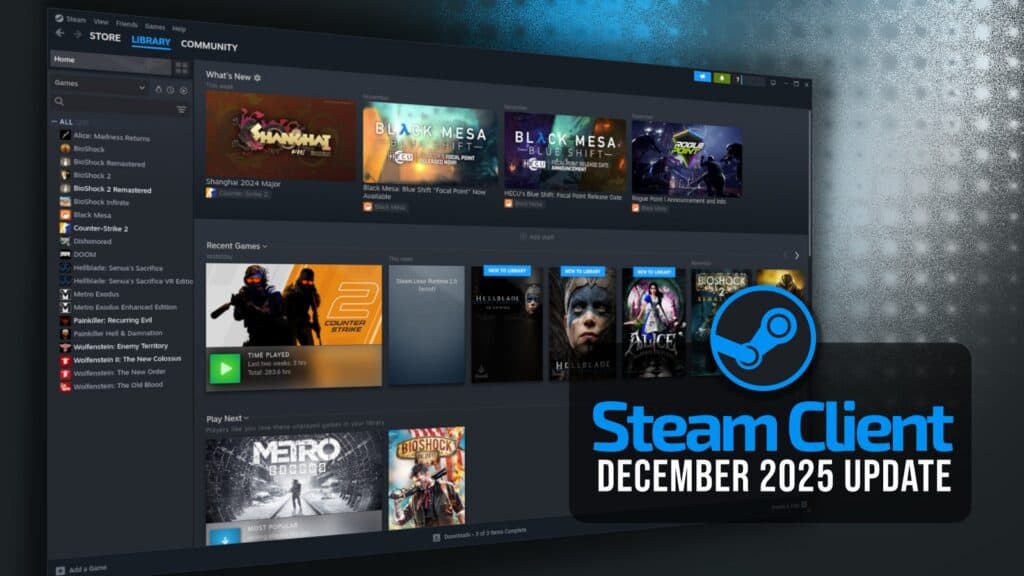
Valve has rolled out a new Steam client update dated December 19, and it’s already being automatically distributed to users.
The most significant change is the transition to a 64-bit Steam client on Windows 10 and Windows 11 systems running 64-bit editions. Valve says systems still using 32-bit versions of Windows will continue to receive updates to the 32-bit Steam client until January 1, 2026, giving remaining users time to migrate.
Alongside this, Valve fixed an issue where non-Steam browser windows could appear unexpectedly when the steamwebhelper process was restarted.
Game recording also received a targeted fix. Valve addressed errors that prevented copying to the clipboard or exporting H.265 videos on systems equipped with NVIDIA 50xx-series GPUs, resolving a problem affecting users who rely on Steam’s built-in capture tools.
In Friends and Chat, Steam now lets you report suspicious or harassing group chat messages directly from the chat window. Users can right-click a message to submit a report and, optionally, block or unfriend the other user.
Big Picture Mode saw stability improvements, with Valve fixing an intermittent issue that caused in-game purchase failures in some titles. Remote Play users should also see improvements, as a bug that prevented moving the mouse between monitors when using touch controls on the Steam Link app has been resolved.
A large portion of the update focuses on Steam Input. Support has been added for Nintendo Switch 2 controllers connected over USB on Windows, as well as GameCube adapters running in Wii U mode with rumble support. Valve also introduced an “Invert Input” toggle for Regular Press activators, allowing button presses and releases to be reversed.
Several gyro-related changes move out of beta and into the default configuration. Newer gyro modes are now enabled by default, while older modes remain available for existing configurations and can be kept visible through Steam Input’s developer settings.
Valve also expanded gyro configuration options, including separate controls for gyro haptic on/off effects and rotation effects, as well as new relative roll and relative pitch toggles for gyro-to-joystick deflection. These options allow joystick output to be centered relative to the controller’s position when gyro input is activated, rather than relying solely on absolute orientation.
Additional Steam Input fixes address configuration stability and controller detection. Valve resolved issues that could cause the configurator to close unexpectedly, prevent changes from saving, or display blank configuration files.
Detection problems affecting DualSense Edge, Xbox Elite controllers, Nintendo Joy-Cons in paired mode, and controller hotplugging in some Unity games were also fixed. Other adjustments include improved DualSense button glyphs, more reliable LED color updates for PlayStation controllers, and corrections to gyro deflection edge cases that could previously result in zero input.
For more information on all changes, see Valve’s announcement.





What is Windows ? And how is that related to Linux(iac) news ?
Now if only Steam would opt for full 64-bit on linux systems without the need for any 32-bit libraries as the newer proton releases have wow64 support to run old 32 and 16-bit titles.