
Over five months after its previous 2025.3 version, the Rhino Linux team has unveiled its latest release, 2025.4, on its Ubuntu-based rolling-release distribution, which features a custom desktop environment (Unicorn) built around the Pacstall package manager.
According to the announcement, over the past months, much of the team’s effort has gone into advancing Lomiri upstream, a mobile-first desktop environment created for Ubuntu Touch, and integrating it more deeply into Rhino Linux, particularly for PINE64 hardware.
As part of this work, the distribution now ships two new packages: rhino-pine-lomiri-core and ubxi-lomiri-desktop. The latter is not limited to PINE64 devices and is also compatible with Rhino Linux generic images.
Alongside the new packages, Rhino Linux has begun rolling out Lomiri as the default desktop environment on PINE64 devices. At the same time, the project is continuing maintenance and support for Unicorn Mobile disk images, ensuring continuity for existing users while the Lomiri transition progresses.
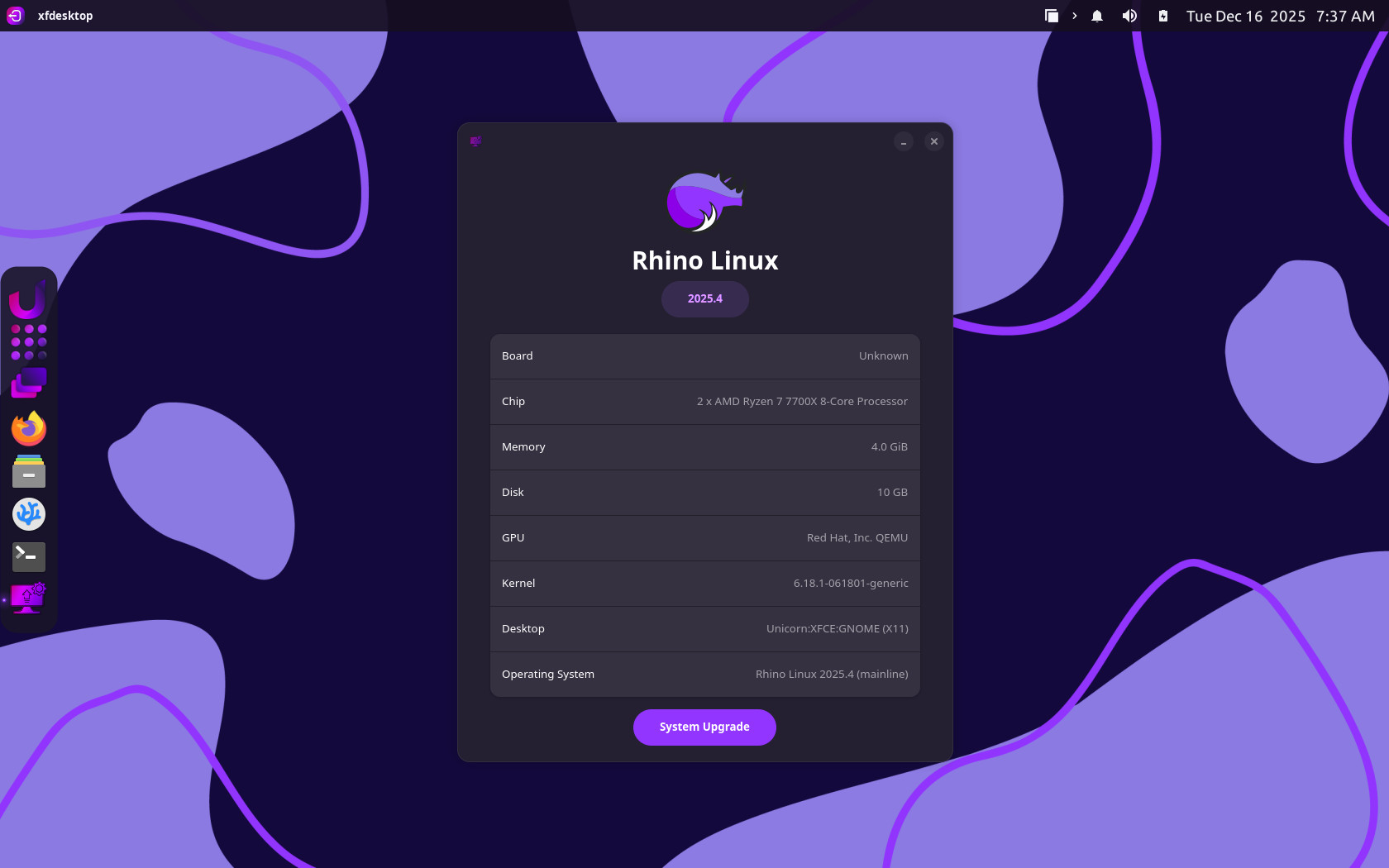
The 2025.4 snapshot also delivers a series of under-the-hood improvements. Multiple long-standing issues in Pacstall have been resolved, addressing stability and usability concerns in the package management workflow.
Kernel updates are another key component of this release, with version 6.18 shipping by default on generic ISO images. Device-specific images receive tailored kernels, including 6.12.62-sunxi for PinePhone and PineTab, 6.18.1-rockchip for PinePhone Pro, 6.9.0-okpine for PineTab2, and 6.17.0-raspi for Raspberry Pi systems.
Looking ahead, the Rhino Linux team has outlined a notable shift in how snapshot releases will be handled in 2026. Rather than holding back an entire snapshot due to platform-specific issues, future releases will prioritize verified images.
Platforms affected by unresolved problems may see delayed or skipped releases, allowing the rest of the ecosystem to move forward more quickly. Devs say that the goal is faster iteration and more timely fixes without blocking progress across all supported devices.
For more information, see the announcement.





If you like …. Really Like…. Really Love purple. Try out Rhino. I don’t really see anything in Rhino that I can’t find in other – distributions with longer history and better development.
It’s great that Lomiri gets more and more available. It’s nowhere near ready, but what is in development needs widespread testing.