

Those of you who remember the fledgling of the Linux desktop will probably smile with a hint of nostalgia as you read this news. It takes us back more than 25 years, thanks to MIDesktop, a modern fork of KDE 1, which just released its first public development preview, bringing the late-1990s KDE desktop experience back to life on current Linux systems.
Previously known as MiDE, the project is a fork of KDE 1 that has been ported to the Osiris toolkit, itself derived from Qt 2, and adapted to run on modern Linux distributions. According to the project’s lead dev, the goal is not to recreate KDE visually alone, but to preserve its original design philosophy: speed, simplicity, and a distraction-free desktop.
If you decide to give it a try, packages are now available for Debian 13 and Ubuntu 24.04 LTS, allowing users to install and run the classic KDE 1 environment without the extensive manual work historically required to make such legacy software function on modern systems. The result is a lightweight desktop that remains responsive even on modest hardware, and looks like this.
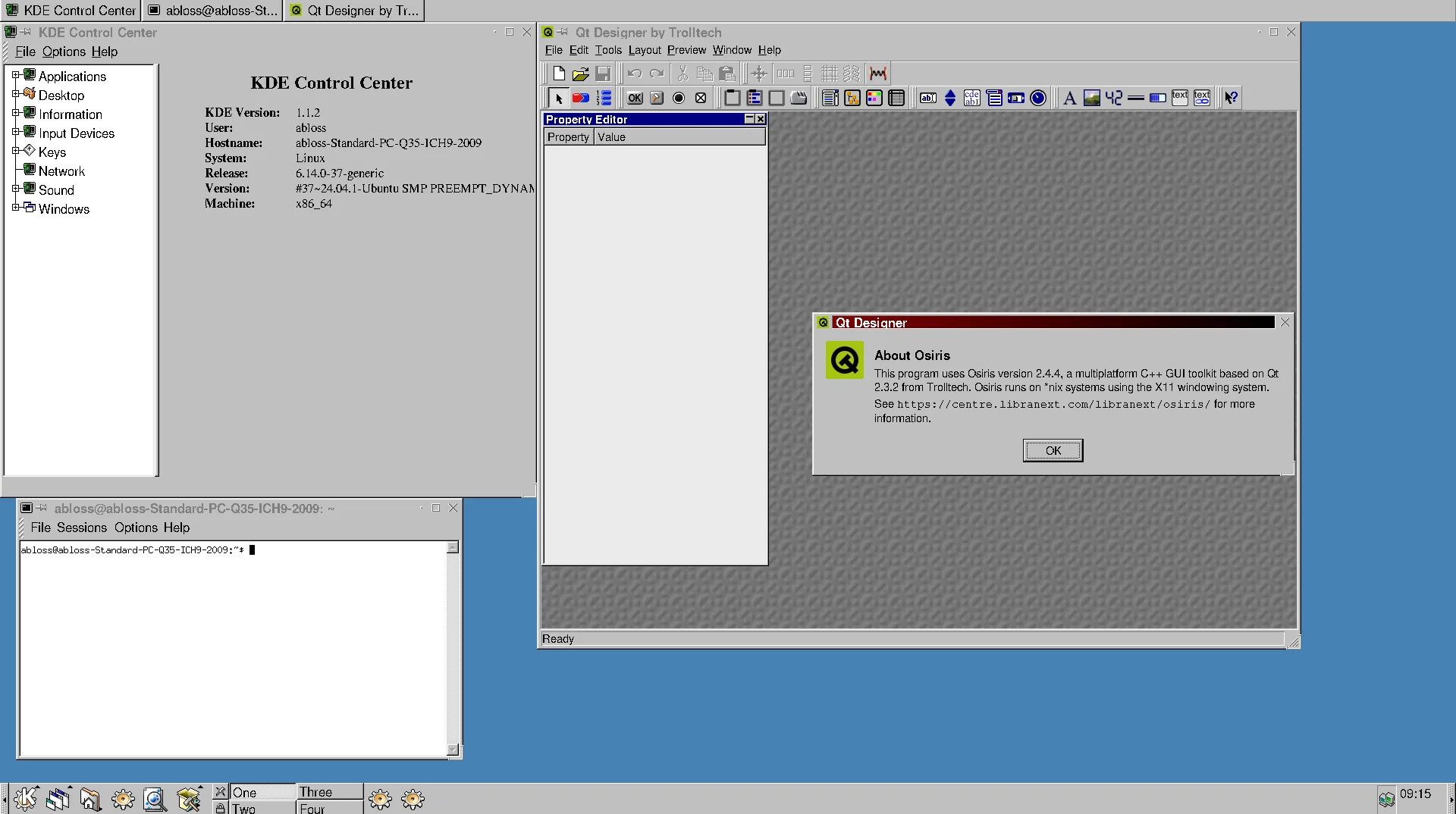
The developer stresses that this release is a development preview. In other words, while the core desktop is usable, it is not considered stable and may contain undiscovered bugs or security issues. As such, MiDesktop is not recommended for production systems or daily use at this stage.
Moreover, several known limitations remain, as modern web browsers are currently the most visible problem. Firefox expands uncontrollably beyond the screen, while Chrome cannot be resized properly. Taskbar menus may appear briefly and then disappear, and the Control Center sometimes fails to expand configuration categories visually. Multi-monitor support is also absent, with the desktop simply spanning all available displays.
Also, keep in mind that at present, only a minimal set of applications is included. Many classic KDE tools, such as editors, calculators, and mixers, are still missing. The developer plans to gradually restore these applications, potentially under adjusted names to avoid confusion with modern KDE software, following an approach similar to that used by Trinity Desktop, a similar project, but focused on KDE 3.
Finally, according to the dev, other items on the roadmap include fixing scrolling behavior across applications, adding power options to the logout menu, rewriting the legacy KDM display manager for modern systems, and restoring sound support using today’s Linux audio stack. A Wayland port is also planned, though it is described as a long-term effort.
For more information, view the dev’s post on Reddit.




I am very much hyped to have the origional KDE brought to modern Linux desktops.
Just seeing that screen shot immediately takes me back to the days when i lugged my Thinkpad 380D around college with very early Linux distros.