The Nitrux team has announced the release of Nitrux 5.1, an immutable, systemd-free Debian-based Linux distro that bets on AppImage-based software delivery and ships with Hyprland as its default desktop environment.
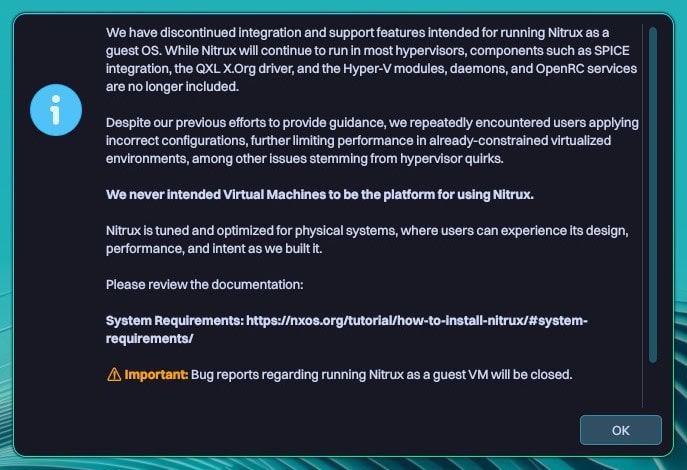
The main (and slightly surprising) change is that the project no longer supports running the distribution as a guest operating system in virtual machines. While Nitrux will still boot under most hypervisors, VM-specific components such as SPICE integration, the QXL X.Org driver, and Hyper-V modules have been removed.
The developers state that Nitrux is designed and tuned exclusively for physical hardware, and bug reports related to virtualized setups will now be closed. If you still try to start Nitrux in a virtual machine, you will receive this message, after which the VM will restart.
Another major highlight is that the release is moving to a single kernel choice. Both ISO images now ship Linux 6.18 LTS built with CachyOS performance patches, ending the long-running use of Liquorix. SCX is now the default process scheduler, paired with ADIOS as the default I/O scheduler, targeting lower latency and more predictable behavior on modern storage and CPUs.
The desktop stack sees broad updates. Hyprland and its utilities have been updated to version 0.52, alongside KDE Frameworks 6.20 and Qt 6.9.2. Waybar has been redesigned with a floating “island” layout, Crystal Dock has been updated to version 2.16, and Wofi adopts rounded geometry throughout its interface.
On top of that, Hyprlock now exposes battery and media information, while Grimshot gains support for window selection in screenshots. Several long-standing annoyances, such as multiple overlapping launcher instances, have also been fixed.
On the networking side, NetworkManager is now configured to use dnscrypt-proxy by default, ignoring DHCP-provided DNS servers to prevent leaks. Firewalld replaces UFW as the default firewall, accompanied by Cinderward, a new MauiKit-based graphical interface intended to simplify everyday firewall management on Wayland systems. Bluetooth configuration has been tightened as well, enforcing secure pairing modes, disabling low-quality headset profiles, and reducing passive device exposure.
Several core system tools undergo rework as NX AppHub reaches version 1.0, with extensive improvements to sandboxing, desktop integration, safety checks, and cleanup logic. The Nitrux Update Tool has been updated to version 2.2.7, introducing file locking, safer reboot handling via Magic SysRq, and stricter validation during rescue operations.
Kernel Boot, SB Manager, and NX Overlayroot have all been hardened with better error handling, validation, and cleanup to reduce failure modes during critical operations such as secure boot signing and overlay management.
New components have been added, too. NX Dynamic PPD and NX Battery Notify introduce adaptive power management and battery health awareness. Wirecloak provides a native WireGuard client with a graphical interface tailored to Nitrux’s immutable design. A new Hardware Compatibility Validation Layer enforces early checks for CPU capabilities, GPU and ISO alignment, and unsupported workflows, aiming to make system behavior more predictable and supportable.
Finally, the release also removes several components, including SwayOSD, nwg-displays, Seatd, Tini, Plasma Firewall, and lingering SysV scripts. According to the project, these removals reflect a continued push toward a cleaner, Wayland-focused stack without systemd dependencies.
For more information, refer to the official announcement.