Linus Torvalds, best known as the creator of the Linux kernel, has quietly published a hobby-oriented open-source project (I know, some care is needed when this word appears in the same sentence as his name) called AudioNoise that blends his recent interest in guitar-pedal tinkering with basic digital-audio effects code.
The repository on GitHub includes small C implementations of effects like delays, filters, and phasers, alongside a Python visualizer that Torvalds jokingly notes was written through “vibe-coding,” an intuitive, rapid style of development.
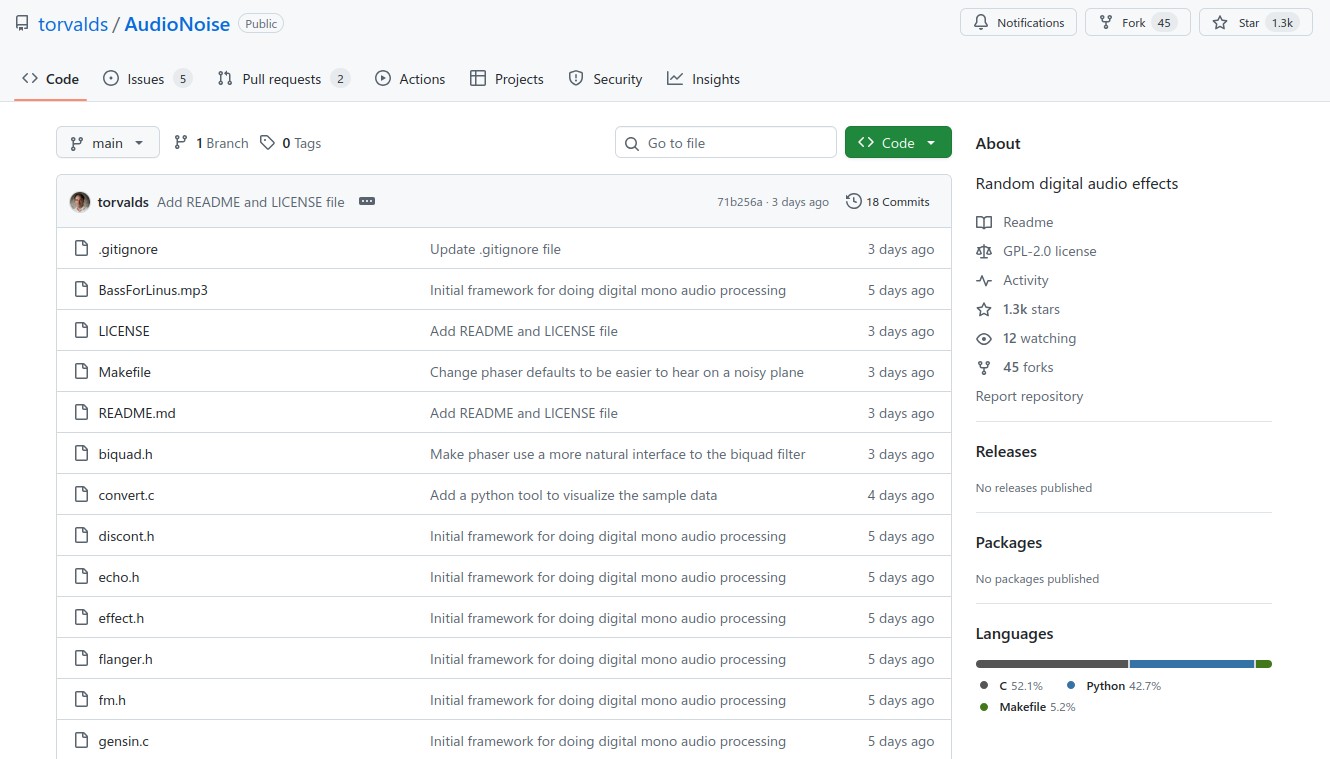
AudioNoise is explicitly framed as a learning exercise rather than a professional audio toolkit. According to its README, the main design goal is to explore the fundamentals of digital signal processing rather than deliver polished software.
The effects are simple and eschew complex techniques such as FFT-based processing; they are implemented as basic IIR filters and delay loops, just enough to simulate “toy” pedal effects. In other words, this is not an audio framework, a library, or a serious attempt to compete with established DSP projects.
AudioNoise, released under the GPL-2.0, the same license long associated with the Linux kernel, arrives in the wake of Torvalds’ earlier GuitarPedal experiments, where he documented his foray into analog circuit design and guitar pedal hardware.
That project was celebrated less for its sonic output and more for showing a side of Torvalds outside his typical realm of kernel development, a tech-centric hobby involving circuit boards and soldering irons rather than power-management patches or merge window drama.
Of course, both AudioNoise and the earlier GuitarPedal efforts are light-hearted personal work that happens to draw attention because of who authored them. While the code and schematics have attracted community interest and stars on GitHub (1,300 in just a few days with 46 forks), the underlying purpose remains exploratory rather than commercially minded.
In conclusion, AudioNoise is best understood as what it claims to be: a personal playground. It certainly won’t change the way audio software is written, but it does offer a reminder that even one of open source’s most influential figures still writes throwaway code for fun. And that’s a good thing.