Godot, an open-source game engine used for creating 2D and 3D games, offering a comprehensive set of tools that allow developers to craft immersive game experiences without the constraints of licensing fees or royalties, has released its latest version, 4.8.
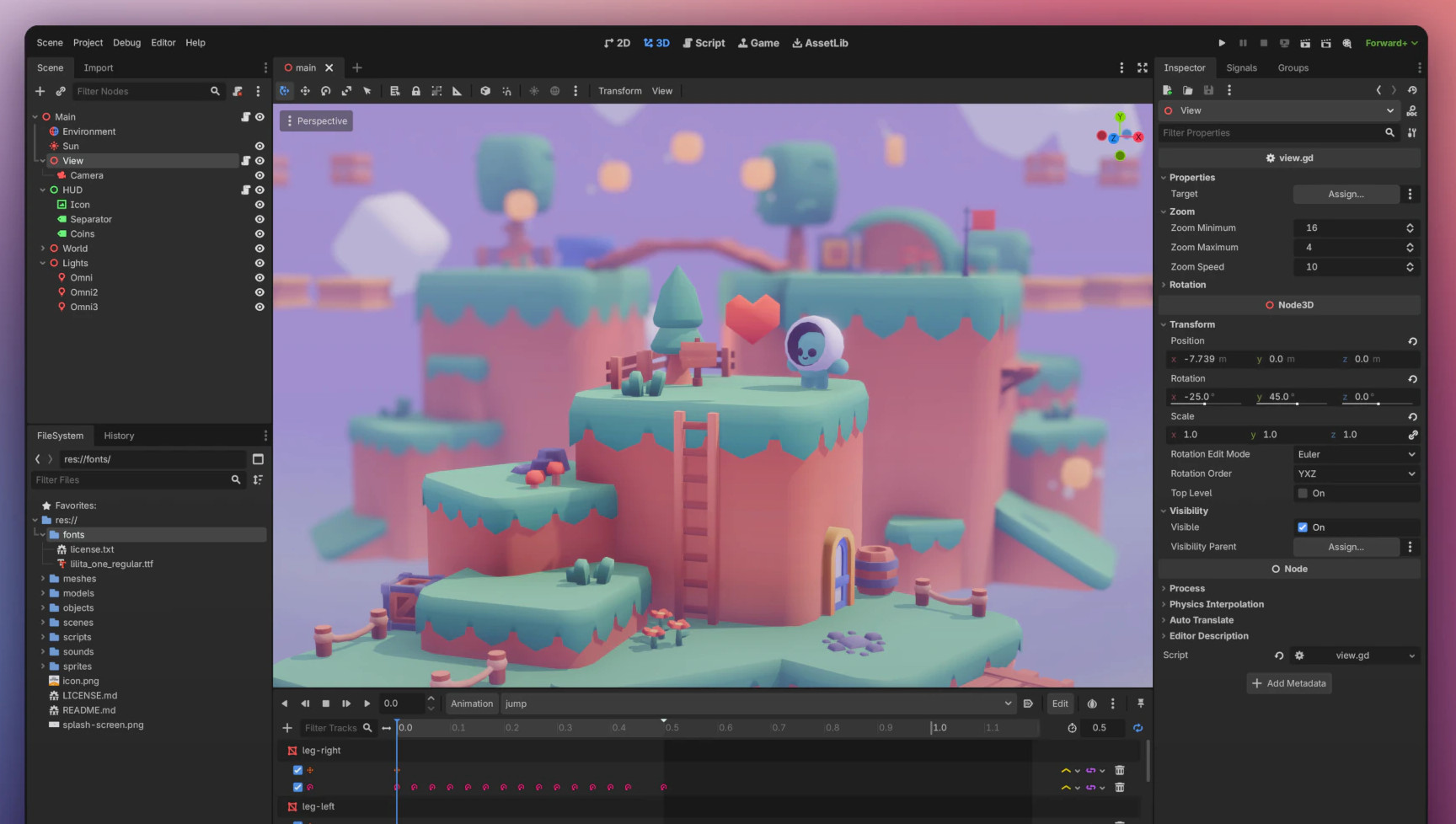
The release’s highlight is the introduction of the new Modern editor theme, now enabled by default. Based on the previously optional Minimal Theme, it refines contrast, spacing, and grayscale balance to reduce visual noise and keep attention on the viewport.
Of course, the older Classic theme remains available for users who prefer it. Alongside the refreshed look, the editor’s docking system has been unified. Bottom panels are now treated like regular docks, allowing panels to be rearranged freely across screen edges or floated into separate windows, an important step toward more flexible workspace layouts.
On the engine side, one of the most important changes is promoting Jolt Physics to the default physics engine for new 3D projects, which was introduced experimentally in Godot 4.4. Existing projects retain their current physics backends, while new projects benefit from Jolt’s faster, more robust simulation out of the box.
Regarding animation workflows, a brand-new inverse kinematics framework has been built around the new IKModifier3D system. Godot 4.6 introduces multiple deterministic and iterative solvers, including TwoBoneIK3D, FABRIK3D, CCDIK3D, and JacobianIK3D, as well as new constraints for joint twist and angular velocity.
Rendering improvements span realism, performance, and platform parity. Screen Space Reflections have been fully overhauled, improving visual stability and roughness handling while also offering better performance, including a half-resolution mode. Reflection and radiance probes now use octahedral maps instead of cubemaps, reducing GPU and memory costs.
Glow blending defaults have been corrected to occur before tonemapping, and the AgX tonemapper now exposes additional parameters for finer control. On mobile and lower-end hardware, material debanding and improved HDR precision significantly reduce color banding, while multiple Vulkan Mobile crash fixes address long-standing issues on Mali and Adreno GPUs.
Apart from the changes mentioned above, dozens of smaller usability improvements landed in 4.6. Selection and transform modes are now decoupled in the 3D viewport, reducing accidental object manipulation. Plus, a new rotation handle aligned to the camera view simplifies common orientation tasks.
Moreover, GridMap drawing now uses the Bresenham line algorithm, eliminating gaps when sketching levels. UI work benefits from visible MarginContainer guides, easier pivot configuration for Control nodes, and separated mouse and keyboard focus behavior.
For developers embedding Godot into custom workflows, 4.6 introduces LibGodot, allowing the engine to be used as a library rather than a standalone executable. This opens the door to tighter integrations in specialized editors, hybrid applications, and custom runtimes on Linux, Windows, and macOS.
Under the hood, GDExtension APIs can now declare required parameters and return values, improving safety for languages with strict type systems. The GDExtension interface itself is now defined in JSON rather than a C header, simplifying tooling and binding generation. GDScript gains a Step Out action in the debugger, improved LSP documentation rendering, and clearer highlighting of string placeholders.
For more information, see the announcement.
Image credits: Godot