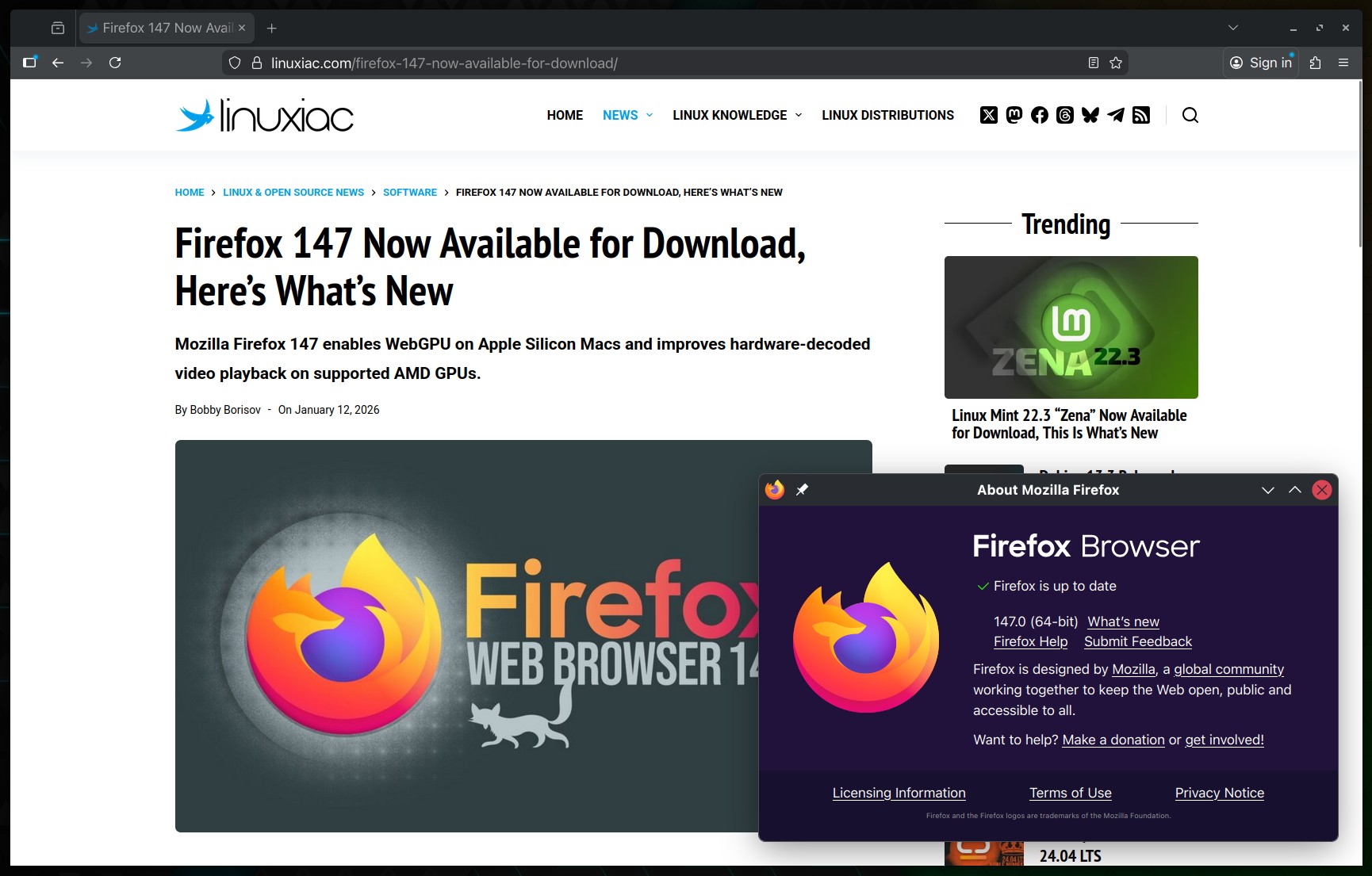
A month after releasing version 146, Mozilla has launched Firefox 147, the latest update to its popular open-source web browser, now available for download.
One of the most visible changes is the expansion of WebGPU support, which is now enabled by default on all macOS versions running on Apple Silicon. On Linux and Windows systems with supported AMD GPUs, Firefox now enables zero-copy playback for hardware-decoded video, reducing memory overhead and improving video playback efficiency.
Firefox 147 also improves desktop integration on Linux by adding support for the Freedesktop.org XDG Base Directory Specification, aligning Firefox’s configuration and data storage with established Linux desktop conventions.
In addition, users running GNOME with Mutter will benefit from sharper rendering on fractionally scaled displays, as window and rendering surface sizes are now matched more precisely to the physical pixel grid.
On the privacy and security side, this version has begun migrating from Safe Browsing V4 to V5, adopting a local-list–based approach that reduces network exposure while maintaining protection against malicious and phishing sites. On Android, Site Isolation is now enabled by default, bringing Firefox for Android in line with desktop Firefox.
There’s also a new usability feature: automatic Picture-in-Picture playback. When enabled, Firefox will automatically open a Picture-in-Picture window if a playing video’s tab is sent to the background, ensuring uninterrupted viewing while multitasking. The feature can be enabled in settings under “Keep playing videos in Picture-in-Picture when switching tabs.”
Performance on the web is further improved with support for Compression Dictionaries, as defined in the IETF RFC 9842. This technology allows websites to reuse shared compression dictionaries, significantly reducing data transfer and improving page load times, especially on constrained connections.
Moreover, Firefox 147 also expands its streaming APIs, with both CompressionStream and DecompressionStream now supporting the Brotli format.
CSS support sees several additions, including anchor positioning, new root-font-relative units (rcap, rch, rex, and ric), and support for the counter-* and quotes properties in the ::marker pseudo-element. Firefox now also supports CSS Module Scripts, allowing stylesheets to be imported directly through JavaScript modules.
Storage and web application compatibility improve with support for Storage-Access-Headers, enabling servers to opt into unpartitioned cookies after prior user consent, and with module service workers. Under the hood, the Unicode ICU library has been updated to version 78, adding support for Unicode 17 and new locales.
Alongside these additions, Firefox 147 includes a series of targeted fixes, addressing drag-and-drop behavior, tab selection issues on Windows, HTTP/3 compatibility problems, and language negotiation inconsistencies by aligning Accept-Language quality values with other major browsers.
Those eager to download this update immediately can do so directly from Mozilla’s servers.
Windows and macOS users can expect an over-the-air update within the following days. Linux users can expect Firefox 147 to appear in their distros’ repositories within the next few days as well.