Rocky Linux 10.3 (Red Quartz) has been officially released following the Red Hat Enterprise Linux 10.3 release on November 11. The new version arrives alongside AlmaLinux 10.3, also released today, giving users two updated free RHEL-compatible options.
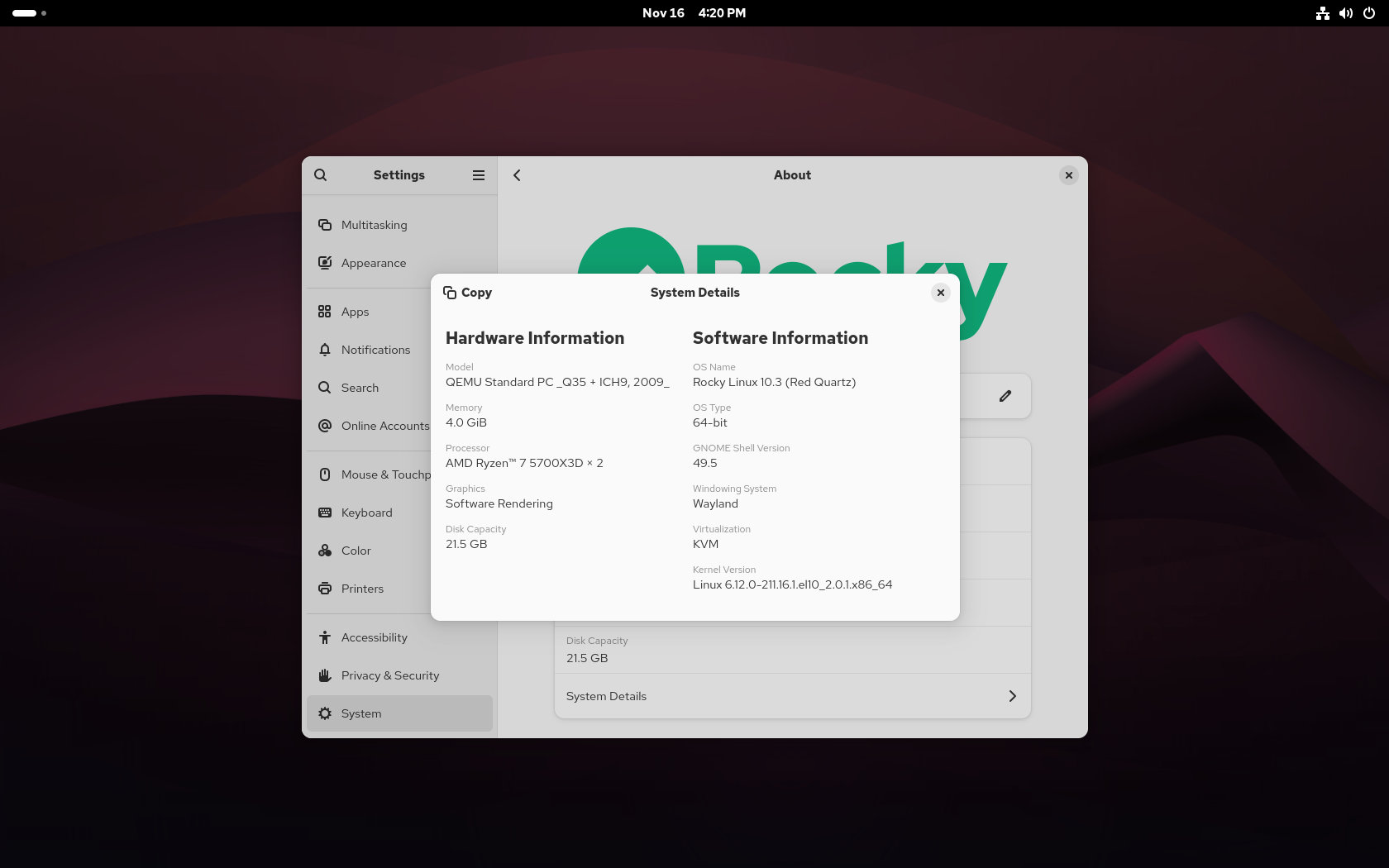
As expected, Rocky Linux 10.3 is built around Linux kernel 6.12, specifically version 6.12.0-264.16.1. Several kernel components have been updated beyond that baseline. The eBPF subsystem and perf tools are rebased to Linux 6.19, while memory management improvements include newer CXL support and changes to compressed swap handling.
Hardware support has also been improved, particularly for Intel platforms, while AMD’s amdxdna driver for Neural Processing Units (NPUs) is now available as a Technology Preview.
On the development side, Rocky Linux 10.3 introduces GCC Toolset 16, featuring GCC 16.2 and Binutils 2.46, alongside LLVM 22.1.8. The update also includes Rust 1.97, Go 1.27.3, and GDB 17.2, giving developers access to newer language features, debugging capabilities, and compiler improvements.
Regarding security, Libreswan 5.4 introduces post-quantum key exchange support through ML-KEM-768 and ML-KEM-1024, while SSH connections operating in FIPS mode now support and prefer hybrid post-quantum key exchange algorithms.
Other security-related updates include Keylime 7.14.3, which improves remote attestation capabilities, and fapolicyd 2.0.1, which introduces parallel policy processing and transactional updates. OpenSC 0.27.1 adds PKCS #11 3.2 support, while the updated Audit 4.2.1 provides additional capabilities for secure remote logging.
System monitoring also receives updates, with Grafana 12.4.3 introducing a redesigned dashboard architecture and improvements to unified alerting. Performance Co-Pilot 7.1.5 adds automatic archive repair and additional performance metrics.
For administrators working with system images, the image-builder command-line interface is now generally available. The web-based image builder can generate bootc-compatible images from locally available base images, while Kickstart gains additional certificate-handling capabilities during installation.
There are several compatibility changes worth mentioning. WEP wireless security support has been removed, along with the ZBUD compressed page allocator. Grafana also drops legacy alerting and AngularJS plugin support, which could affect existing monitoring configurations.
Regarding supported architectures, Rocky Linux 10.3 is available for x86-64-v3, ARM64, RISC-V, POWER10 and newer (ppc64le), and IBM z15 and newer. As with previous Rocky Linux 10 releases, older x86-64-v2 processors are not supported.
Existing Rocky Linux 10 users can upgrade to version 10.3 using the standard sudo dnf -y upgrade command or graphical update tools. However, upgrades from Rocky Linux 8 or 9 to version 10 are not officially supported, with a fresh installation recommended instead.
Installation ISOs, container images, cloud images, and live images are available from the Rocky Linux downloads page. For more information, see the official announcement.