Following the release of Red Hat Enterprise Linux 10.3, AlmaLinux 10.3 is officially available, codenamed “Mauve Lion”, powered by the Linux kernel 6.12.
One of the most interesting changes concerns security patches. According to the AlmaLinux developers, the new kernel includes fixes for 36 CVEs not addressed in the corresponding RHEL 10.3 kernel at release time.
Of these, 30 were fixed in RHEL 10.2 but missing from the RHEL 10.3 kernel. The AlmaLinux team restored those fixes to prevent previously addressed vulnerabilities from being reintroduced during upgrades. The remaining six fixes were added in response to community requests and were not included in RHEL.
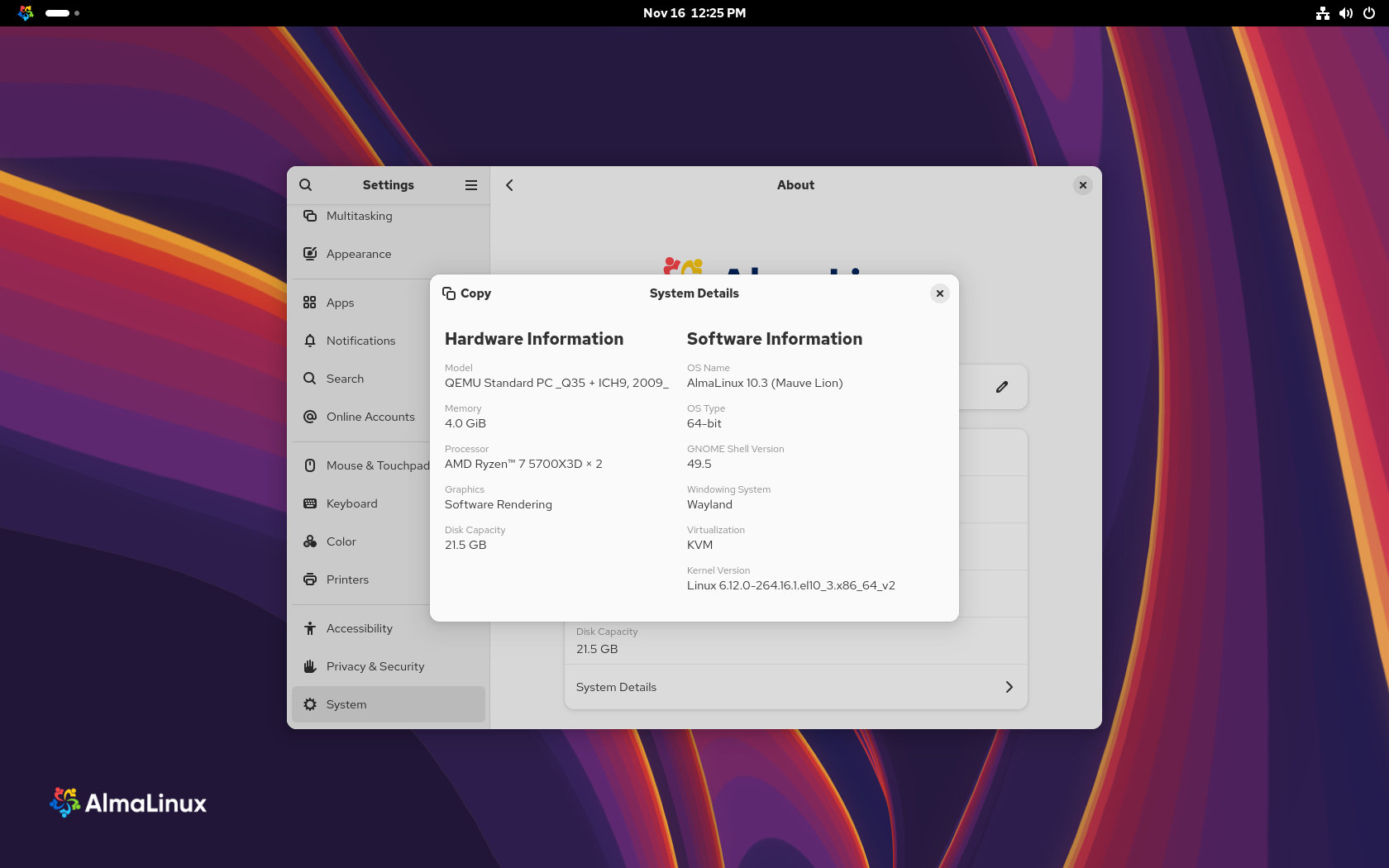
On the container management side, AlmaLinux 10.3 upgrades to Podman 6, introducing several changes administrators should consider before upgrading existing container hosts.
Most notably, support for CNI networking has been removed, leaving Netavark as the sole networking backend. The BoltDB database backend was dropped in favor of SQLite, while pasta replaces slirp4netns for rootless networking. Additionally, cgroups v1 support was removed, and firewall management now relies on nftables instead of iptables.
Another change concerns container configuration. Vendor defaults now reside under /usr/share/containers, while existing configurations in /etc/containers remain intact and keep precedence. Separate configuration directories for rootful and rootless container storage are also supported.
For web server administrators, AlmaLinux 10.3 restores the ModSecurity web application firewall, which was available in AlmaLinux 8 and 9 but absent from versions 10.0 through 10.2.
The new release includes ModSecurity 2.9.14 alongside OWASP Core Rule Set 4.22. Since CRS 4 changes the rule structure, administrators migrating existing configurations from AlmaLinux 9 should review their custom rules before deploying them in production.
Moving on to development tools, AlmaLinux 10.3 introduces GCC Toolset 16, LLVM Toolset 22, Rust 1.97, Go 1.27, GDB 17.2, and Node.js 26.
GCC Toolset 16 changes its default C++ standard from GNU++17 to GNU++20. Projects requiring the older standard can continue using it by specifying the -std=gnu++17 compiler option. The system compiler’s default remains unchanged.
Security-related package updates include fapolicyd 2.0, Keylime 7.14, and audit 4.2, with the latter introducing post-quantum TLS support for remote logging. Libreswan 5.4 also adds support for ML-KEM post-quantum key exchange.
The fapolicyd update is relevant for hardened systems, introducing parallel policy decisions and transactional updates to the policy and trust database. Administrators using custom rules should test their configurations before upgrading production systems.
AlmaLinux 10.3 also retains several features introduced earlier in the 10.x series, including Btrfs support, the CRB repository enabled by default, x86-64-v2 builds for older processors, and 32-bit userspace packages. Extended hardware support and additional virtualization capabilities also remain available.
Alongside the 10.3 release, the AlmaLinux team has also announced AlmaLinux 9.9, codenamed “Chartreuse Bobcat,” following RHEL 9.9. This update includes security fixes, refreshed system packages, and updated development tools for users continuing with the AlmaLinux 9.x series.
For more information, refer to the announcement or the AlmaLinux 10.3 release notes.
Installation images are available for x86_64, x86_64-v2, AArch64, ppc64le, and s390x architectures. Live images and generic cloud images are also available, with additional cloud, container, and Raspberry Pi images being rolled out separately.