Mark Harmstone, the developer behind the WinBtrfs filesystem driver for Windows, has released Moxnox 1.0, an experimental open-source operating system combining Windows NT-inspired architecture, POSIX compatibility, and native Btrfs support.
Developed as a hobby project since 2022, Moxnox is an independent operating system, not a Linux distribution or Windows clone. Version 1.0 has about 130,000 lines of C++ code and supports x86-64 and ARM64 architectures.
Moxnox is particularly interesting because of its system design. Its system calls and low-level interfaces are modeled after Windows NT, while its filesystem layout and application environment follow Unix conventions. Unlike ReactOS, which aims to recreate Windows compatibility, Moxnox uses its own kernel architecture.
Executables use Windows’ Portable Executable format rather than Linux’s ELF format, with programs and libraries having .exe and .dll extensions. At the same time, the system uses Unix-style filesystem paths and supports functionality such as fork, which is absent from the traditional Windows API.
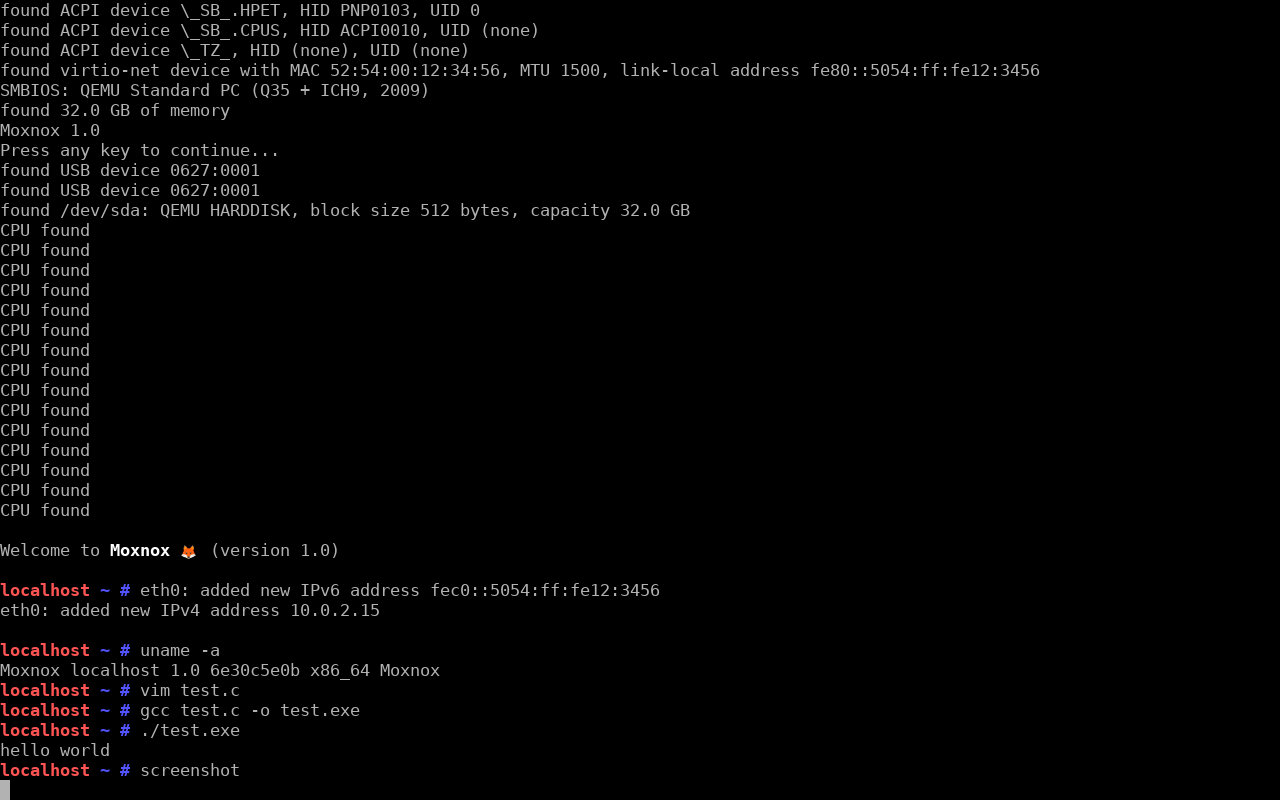
One important distinction is that Moxnox cannot run existing Windows applications, despite its NT-inspired interfaces. The developer suggests that porting Wine’s Win32 libraries could eventually provide such functionality, but this is not currently implemented.
The list of ported software includes Bash, GNU Coreutils, GCC, LLVM, Git, Python, Perl, Rust, OpenSSH, OpenSSL, Vim, Nano, and various other development tools. GCC is currently available only for x86-64.
Another important milestone is self-hosting, meaning Moxnox can compile its own operating system components without relying on Linux or Windows as the build environment. Some limitations remain because GCC, Rust, and a few other applications cannot yet be compiled directly within Moxnox.
On the storage side, the operating system uses Btrfs. Given Harmstone’s experience developing WinBtrfs, an open-source Windows driver providing read and write access to Btrfs filesystems, this choice is expected. However, he warns that Moxnox’s Btrfs implementation has not been extensively tested and should only be used with disposable filesystems.
Regarding hardware, Moxnox supports NVMe, SATA, SD cards, USB mass storage, and VirtIO block devices. Networking support includes VirtIO adapters and selected Realtek controllers, while input devices include USB HID and PS/2 keyboards and mice.
Graphics support is currently limited to framebuffer and text-console functionality, including VirtIO GPU, GOP framebuffer, VBE, and VGA text console. There is no graphical desktop environment.
The x86-64 builds target the x86-64-v3 instruction set, while ARM64 requires ARMv8.1 or later. This also makes Raspberry Pi 5 a supported platform, provided it uses suitable UEFI firmware.
Despite reaching version 1.0, Moxnox remains an early-stage experimental project. It lacks multiuser support, proper security mechanisms, multiple keyboard layouts, time zone support, and broader locale handling. Performance limitations remain, particularly in memory allocation and networking.
For more details, including installation instructions and source code, visit the project’s GitHub repository. The Moxnox 1.0 binaries are available on the releases page.
For anyone interested in experimenting with the system, prebuilt x86-64 and ARM64 disk images and EFI kernels are available, along with instructions for testing Moxnox under QEMU or installing it on physical hardware.