The Kali team has announced Kali Linux 2026.3, the third update this year for the Debian-based distribution focused on penetration testing and security auditing.
It introduces six new security tools, KDE Plasma 6.7, Linux kernel 7.1.5, improvements to Kali NetHunter, and a major refresh of the distribution’s image-building scripts.
The latter is a main change in this release. Kali’s developers have standardized the build scripts used to generate official installation and system images, giving them a more consistent structure, command-line options, and behavior across supported platforms.
Another important addition is support for building Kali images inside Docker or Podman containers. Each refreshed script now includes a build-in-container.sh helper that detects the available container engine and prepares the necessary environment.
Users can customize builds by selecting different architectures, branches, installer variants, hostnames, and additional packages. However, the transition isn’t finished, with remaining scripts expected to be updated for Kali Linux 2026.4.
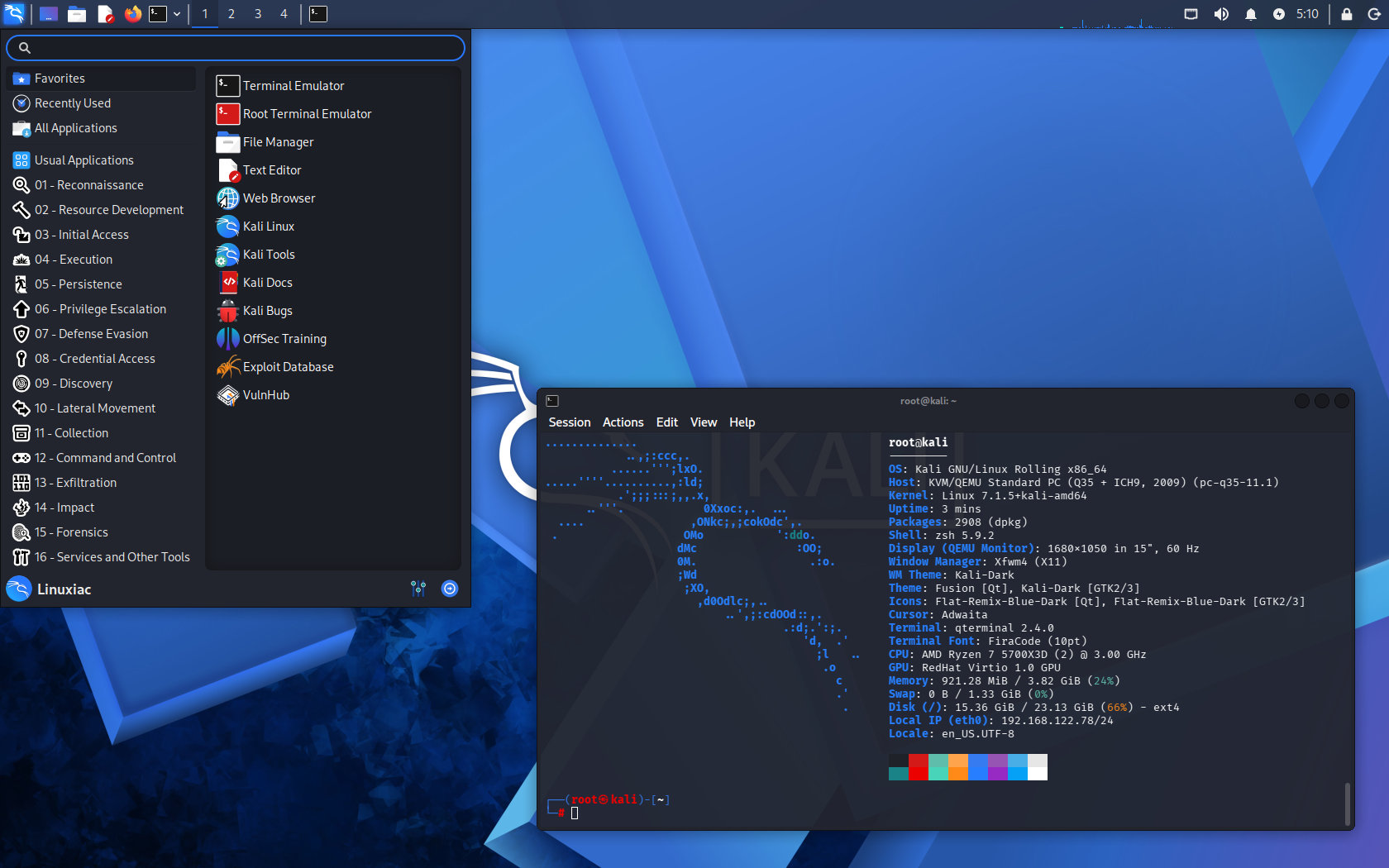
On the desktop side, Kali Linux 2026.3 upgrades KDE Plasma to version 6.7, introducing per-screen virtual desktops, improved navigation through the Overview interface, and additional Wayland protocol support. Performance and power consumption are also optimized, particularly for Intel integrated graphics and workloads with multiple full-screen windows.
Other Plasma improvements include the ability to duplicate network connections and refinements to System Monitor. Kali also refreshed application icons, making security tools easier to identify in the application menu.
As usual, the release expands the distribution’s security toolkit. Six new applications are now available through Kali’s repositories:
- Dalfox: An open-source XSS vulnerability scanner designed for automated security testing.
- Katana: A web crawling and spidering framework for discovering endpoints and application resources.
- qsreplace: A command-line utility for replacing query-string parameter values in URLs.
- RustScan: A fast port scanner written in Rust.
- SDRangel: A Qt-based application for working with software-defined radio devices.
- Snaffler-NG: A tool for discovering credentials and sensitive information in SMB shares.
The release includes 126 package updates, with the Linux kernel moving from version 6.19 to 7.1.5.
Kali NetHunter, the distribution’s mobile penetration testing platform, also receives several improvements. One unusual addition is wardriving support for TicWatch Pro 3 smartwatches, allowing compatible devices to use their internal wireless hardware in monitor mode with tools such as Aircrack-ng and Kismet.
There’s also WearHunter, an experimental feature that allows users to control a NetHunter-enabled smartwatch from their phone over ADB using Wi-Fi or Bluetooth. NFC Arsenal can now access NFC functionality from the Kali chroot environment, supporting operations with MIFARE Classic cards without requiring an external adapter.
Finally, KernelSU support has been added, along with fixes for compatibility issues between newer systemd/udev components and older Android kernels. Additional NetHunter kernels are available for several devices, including Google Pixel, Motorola, Sony Xperia, and Xiaomi models.
For more information, refer to the official release announcement.
Kali Linux 2026.3 installation images are available from the project’s download page. Existing users running Kali Rolling can upgrade their systems using sudo apt update && sudo apt -y full-upgrade.