ReactOS, an open-source operating system designed to be binary-compatible with Microsoft Windows, has announced the release of ReactOS 0.4.16 after about a year and a half of development.
One of the most visible changes is the new graphical installer. Until now, the project distributed separate LiveCD and BootCD images: one for testing ReactOS without installing it and another with the long-standing text-based setup for installation.
With 0.4.16, these functions are combined into a single image. Users can now boot ReactOS, try it, and install it from the same media using the new graphical setup, which also offers basic partition management.
Regarding GPU support, ReactOS developers fixed a long-standing slowdown affecting NVIDIA graphics drivers, traced to the kernel running out of system page table entries when loading third-party drivers. Additionally, AMD users benefit from a fix for an issue causing blank OpenGL windows.
Audio support advances with a new High Definition Audio bus driver. The previous hdaudbus.sys implementation was incomplete and could cause crashes when installing HD Audio drivers.
The replacement should allow HD Audio controllers compatible with Windows XP and Windows Server 2003 to work under ReactOS, including hardware using audio solutions from AMD, IDT, NVIDIA, Realtek, and SigmaTel.
ReactOS 0.4.16 also fixes volume and balance handling so settings are restored after reboot when using HD Audio codecs. Changes to audio device enumeration expand support for more sound hardware.
On the storage side, since 2009, ReactOS has relied on the UniATA driver for SATA and AHCI support and partitions larger than 8 GB. Over time, UniATA became linked to slow booting and failures on newer systems. To address this, ReactOS 0.4.16 introduces a new ATA driver to fix those issues and let the OS boot in more environments.
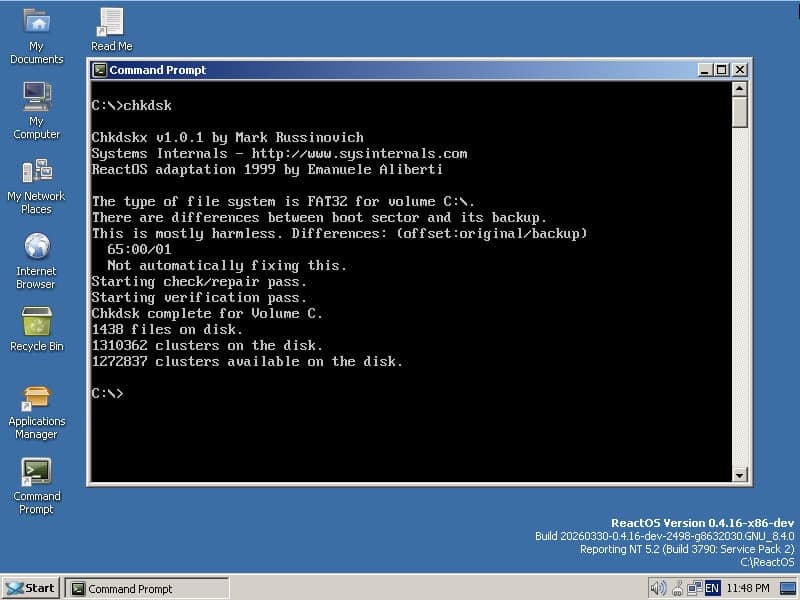
The release also restores the ability to repair FAT partitions using chkdsk with Microsoft’s open-source FastFAT driver and introduces a new disk cleanup utility. This utility supports extensions compatible with Windows Disk Cleanup, allowing third-party applications to help clean unnecessary files.
Networking has also improved. ReactOS now supports asynchronous connections, letting applications perform network operations without blocking while waiting. Together with the newer DC21X4 network driver introduced during earlier development, ReactOS 0.4.16 can now both boot and access the Internet under Microsoft Virtual PC 2007 and Hyper-V Generation 1.
But perhaps the most important long-term change, however, concerns ReactOS’s relationship with Wine. ReactOS uses portions of Wine to implement Windows APIs, although unlike Wine on Linux or other Unix-like systems, ReactOS integrates that code directly with its own Windows-compatible kernel.
For years, the project remained tied to Wine 2.x and 3.x because ReactOS developers aimed to preserve compatibility with Windows Server 2003 APIs. Adopting newer Wine code became difficult as modern Wine releases depended on APIs from later Windows versions.
Toward the end of the ReactOS 0.4.15 development cycle, the project abandoned that strict Server 2003 compatibility requirement. That decision has let developers begin progressively updating their Wine fork toward Wine 10.0, and ReactOS says 0.4.16 already includes a significant amount of that work.
Moreover, developers can experimentally enable exports for Windows Vista and newer applications when compiling ReactOS themselves. More importantly, updating the code base to Wine 10 should make future synchronization with Wine 11 and later releases easier.
For additional details, see the official announcement.
Keep in mind that ReactOS remains a work in progress rather than a drop-in replacement for modern Windows. But even with that clarification, 0.4.16 addresses several of the project’s long-standing limitations and lays the groundwork for broader hardware and application compatibility in future releases.
Image credits: ReactOS