Debian developers have decided on a major question: how to use generative AI in the project, choosing a middle ground and voting for the “Responsible Use of Generative AI” proposal. This sets a direction that is open to AI but focused on accountability.
This decision follows a two-week General Resolution vote where Debian devs considered nine different options, ranging from a full ban on LLM-assisted contributions to allowing them under certain conditions. The outcome will affect how Debian contributors work now and how the project handles new AI tools in the future.
Option 5, “Responsible Use of Generative AI,” won the vote. Using Debian’s Condorcet voting system, it was the only option in the Schwartz Set and beat all other remaining choices.
The vote margins were significant. “Responsible Use of Generative AI” beat “Allow AI-Assisted Contributions with conditions” by 203 to 148, “Accept AI contributions for Debian-specific work” by 232 to 115, and a more cautious proposal by 210 to 130. It also won over the “Debian is created by humans” option by 251 to 139.
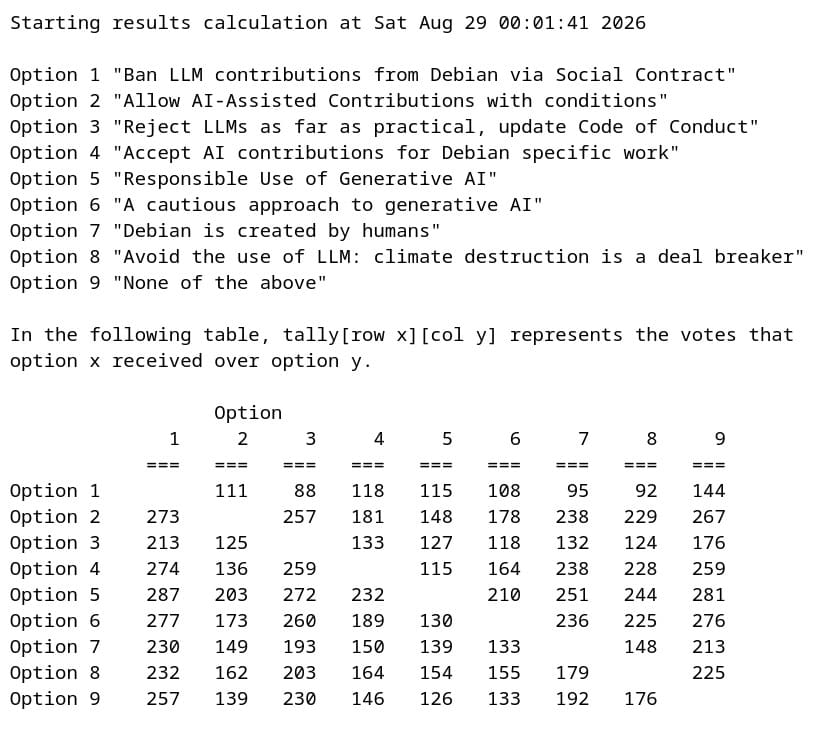
Notably, the proposal to ban LLM contributions through Debian’s Social Contract did not reach the required majority. In contrast, several proposals allowing some AI-assisted work did pass their thresholds. So, what does this decision mean for Debian?
Debian’s new policy does not endorse or ban generative AI tools for developing, maintaining, or documenting software and other project materials. It recognizes that these tools can boost productivity when used responsibly, letting volunteers focus more on tasks that need technical skill, judgment, and teamwork.
However, the key point is that responsibility always stays with the human contributor. In light of this, contributions made with AI must meet the same standards for quality, accuracy, maintainability, and legal compliance as any other work. Using AI does not lessen the contributor’s responsibility for their submissions.
Importantly, Debian does not require contributors to label AI-assisted work. While disclosure is encouraged, it is not required. This makes the chosen proposal less restrictive than some other options that were considered.
There are also strict limits when using external AI services. Contributors must not share confidential information, private messages, security vulnerabilities, cryptographic keys, credentials, or other non-public Debian data with third-party AI services unless they have clear permission and follow Debian’s security and privacy rules.
Overall, Debian’s decision is clear. The project will not treat “AI-generated work” as a separate category with different rules. Instead, generative AI is seen as just another tool, and the person submitting the work is still fully responsible for it.
And this difference really matters. Debian is one of the oldest, largest, respected, and most influential community-driven Linux distributions. It has thousands of packages and a huge downstream ecosystem. Decisions made by Debian often affect not just Debian, but also Ubuntu and many other Linux distributions based on it.
By choosing responsible use instead of a ban, Debian clearly recognizes that AI-assisted development will likely stay in modern software. At the same time, the project makes it clear that automation cannot replace understanding, review, judgment, or accountability.
This decision will likely shape Debian’s development long after today’s AI tools are replaced by future technologies. For additional details, see Debian’s official announcement.