The DB-Engines ranking of the most popular database management systems for January 2026 is now available, featuring data on the past 12 months’ popularity trends for 429 databases, highlighting the platforms that dominated the data management scene in 2025.
At the top of the list, Oracle Database sustained its position as the most widely used database system worldwide throughout 2025. Close behind Oracle, MySQL maintained its status as one of the most-deployed open-source relational database engines, while MariaDB remained lower but firmly in the upper tier.
Microsoft SQL Server held a stable third place, sustaining demand among enterprise customers and in hybrid cloud deployments. In fourth place, PostgreSQL registered notable growth in 2025, reinforcing its reputation as the fastest-growing open-source database among core relational systems.
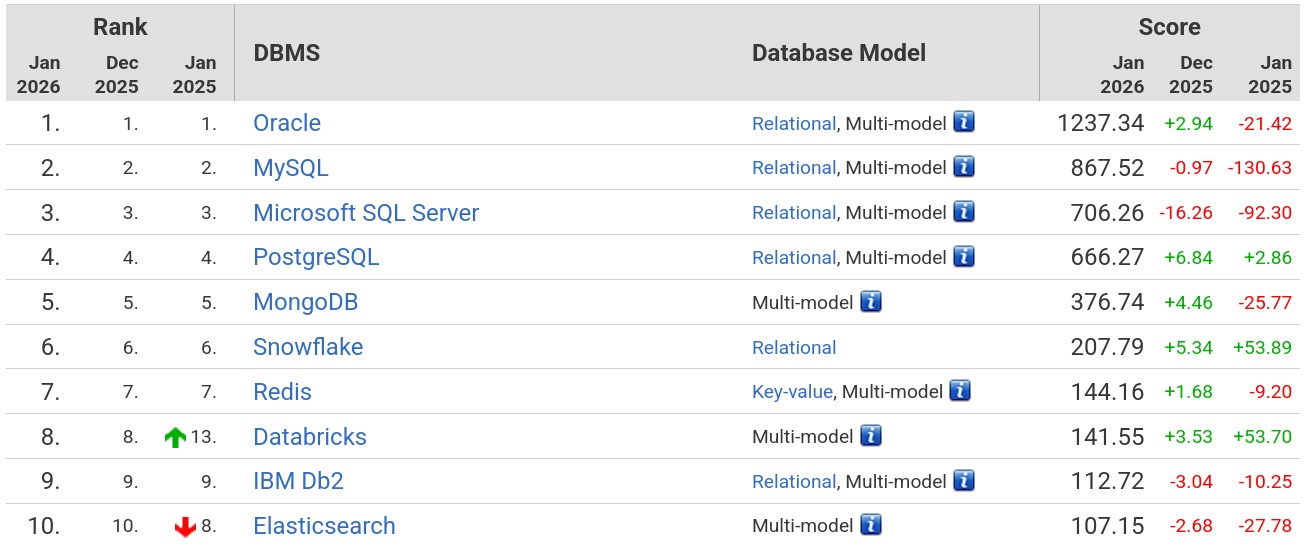
Among non-relational and hybrid systems, MongoDB remained among the most popular databases.
Cloud-native analytics platforms such as Snowflake experienced persistent growth, emerging as significant contenders for data warehousing and large-scale analytics workloads. Similarly, unified data platforms like Databricks gained visibility across machine learning and AI-driven pipeline use cases.
Among in-memory key-value stores, Redis remained firmly ahead in overall popularity throughout 2025, while its competitor, Valkey, ranked lower. SQLite, by contrast, continued to rank highly overall due to its pervasive use as an embedded database rather than direct competition in the caching space.
To wrap things up, the open-source side clearly holds a slight edge. Open-source databases account for just over half of the total market share, while proprietary systems account for just under half. In percentage terms, this places open-source databases in the low-to-mid-50% range, with commercial databases in the mid-to-high-40% range.
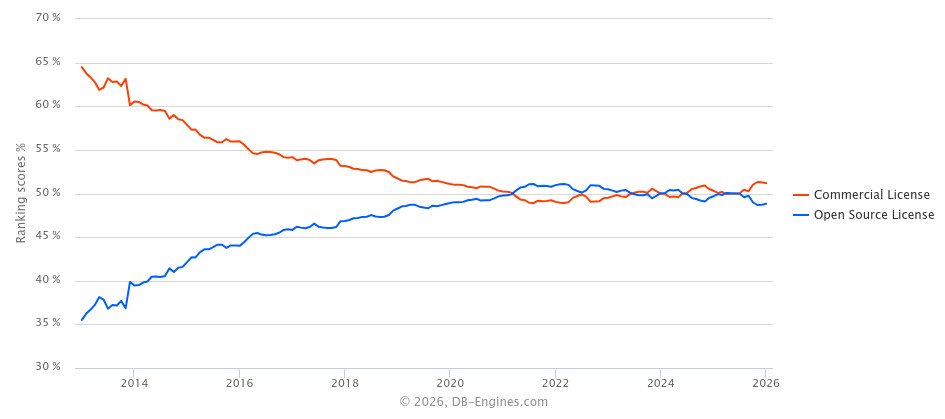
For more information, visit the statistics on the DB-Engines website.
Keep in mind that DB-Engines ranking does not measure actual installations or usage. Instead, it’s based on a composite popularity score that combines several indicators, including search engine queries, discussion activity on technical forums, job postings, mentions on professional websites, and general online interest.